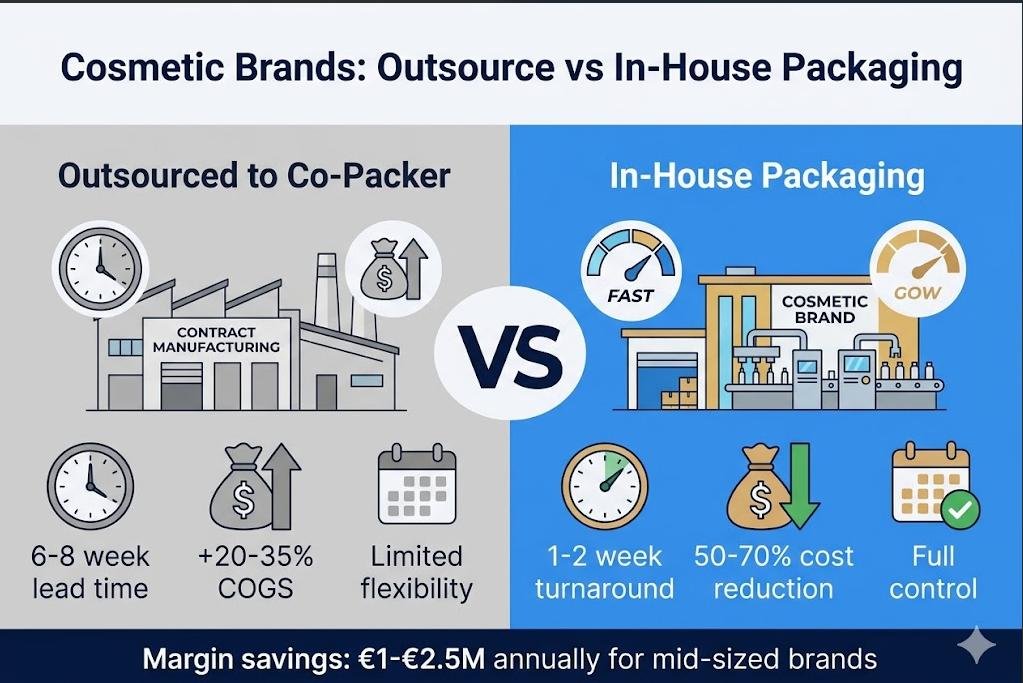
A quiet shift is happening in the cosmetics industry: mid-sized and large brands are buying their own packaging equipment and bringing filling, sealing, and labeling operations in-house instead of outsourcing to contract manufacturers.
This isn’t a fringe trend. Major cosmetic brands — including several in the €50–€500 million revenue range that previously relied entirely on co-packers — have invested in filling lines, tube sealers, pump assembly equipment, and labeling machines over the past three years. The drivers are margin control, supply chain resilience, speed to market, and the ability to launch limited-edition or customized products without waiting for a contract manufacturer to fit them into a production schedule.
For contract manufacturers (co-packers), this is a structural threat. For packaging machinery suppliers, it’s an opportunity — but only if they understand what cosmetic brands actually need, which is very different from what traditional industrial packaging buyers need.
Here’s what’s driving the shift, what challenges brands face when they bring packaging in-house, and where the opportunities sit for machinery suppliers, raw material vendors, and consultants who can help brands navigate this transition.
Why cosmetic brands are verticalizing packaging
1. Margin pressure from retailers and e-commerce platforms
Cosmetic brands face intense margin pressure from retailers (who demand higher trade margins and promotional support) and e-commerce platforms (Amazon takes 15–30% of revenue depending on category and fulfillment model).
Outsourcing packaging to a co-packer typically adds 20–35% to the cost of goods sold (COGS). For a brand selling a €20 moisturizer, that’s €4–€7 per unit in packaging and filling costs.
Bringing packaging in-house can cut that by 50–70% once equipment is amortized and processes are optimized. Savings: €2–€5 per unit. For a brand selling 500,000 units/year, that’s €1–€2.5 million in annual margin improvement.
That’s not pocket change. It’s the difference between 25% gross margin (breakeven) and 35% gross margin (profitable enough to reinvest in marketing and product development).
2. Supply chain disruptions and co-packer capacity constraints
COVID-19 and subsequent logistics disruptions exposed the fragility of outsourced packaging. Brands that depended on contract manufacturers faced delays (co-packers prioritized their largest clients), capacity shortages (popular time slots booked months in advance), and rigid minimum order quantities that didn’t fit smaller or test-launch runs.
Brands with in-house packaging could respond faster: launching hand sanitizer or face masks in 2020–2021 when demand spiked, adjusting production volumes in real-time as demand shifted, and avoiding the bottleneck of waiting for co-packer availability.
Post-pandemic, many brands decided that control over production timelines was worth the capital investment in equipment.
3. Faster speed to market for limited editions and customization
The cosmetics market is increasingly driven by limited-edition launches, influencer collaborations, and personalized products — all of which require short production runs, fast turnaround, and flexibility that contract manufacturers struggle to provide.
A brand launching a limited-edition serum with a celebrity influencer might need 10,000 units filled, labeled, and shipped within three weeks. A contract manufacturer will quote a 6–8 week lead time (because they have other clients in the queue) and a minimum order quantity of 25,000 units (because short runs are inefficient for them).
With in-house packaging, the brand can run the limited edition overnight, ship it within a week, and avoid overproducing inventory that may not sell.
4. Quality control and IP protection
Cosmetic formulations are IP-sensitive. Brands don’t want their formulas sitting in a co-packer’s facility where competitors (who may also use the same co-packer) could potentially reverse-engineer them.
In-house packaging gives brands full control over formulation security, quality assurance, and process adjustments without exposing proprietary information to third parties.
What challenges brands face when they bring packaging in-house
1. Capital investment and equipment selection
Packaging equipment for cosmetics isn’t cheap. A semi-automatic filling line for tubes or bottles costs €30,000–€80,000. A fully automatic line with integrated filling, capping, and labeling costs €150,000–€500,000 depending on output and level of automation.
For a mid-sized brand, this is a significant capital outlay — and if they choose the wrong equipment (wrong speed, wrong format flexibility, wrong level of automation), the investment doesn’t deliver the expected ROI.
Brands often have no in-house expertise in packaging machinery, so they rely on suppliers to guide them — but suppliers have an incentive to sell more expensive, higher-capacity equipment than the brand actually needs.
2. Operator training and process optimization
Running a cosmetic packaging line isn’t as simple as pressing a button. Operators need to understand:
- Formulation viscosity and how it affects filling accuracy
- Temperature control for hot-fill products
- Sealing parameters for tubes and pumps
- Changeover procedures for different SKUs
- Quality control and reject handling
Brands hiring operators from outside the cosmetics industry (food packaging, pharmaceuticals) discover that cosmetic packaging has unique challenges: high-viscosity creams, air-sensitive formulations, fragile glass bottles, tight tolerances on fill weight.
Planning to buy this equipment? Tell us your capacity and budget — we reply within 24 hours.
Get a factory-direct quote on WhatsAppTraining takes time, and until operators are proficient, reject rates are high and throughput is low.
3. Regulatory compliance and GMP
Cosmetic packaging must meet Good Manufacturing Practice (GMP) standards. In the EU, that’s Regulation 1223/2009. In the US, it’s FDA CFR Part 211 (for OTC drugs) or voluntary GMP guidelines for cosmetics.
Brands bringing packaging in-house become responsible for:
- Cleanroom or controlled-environment production (depending on product type)
- Documentation and batch traceability
- Microbiological testing and contamination control
- Stability testing and shelf-life validation
A contract manufacturer already has this infrastructure. A brand building it from scratch needs to invest in facility upgrades, quality systems, and compliance expertise.
4. Spare parts, maintenance, and technical support
When a filling machine breaks down at a contract manufacturer, the co-packer’s maintenance team fixes it. When the same machine breaks down at a brand’s in-house facility, the brand needs to:
- Stock spare parts (or wait for parts to ship from the supplier, often in China or Europe)
- Have trained technicians who can diagnose and repair faults
- Maintain relationships with the equipment supplier for ongoing support
Many cosmetic brands underestimate the cost and complexity of maintaining packaging equipment. A machine that runs smoothly for the first six months can become a nightmare when a sensor fails, a sealing head needs replacement, or a software glitch shuts down production.
What cosmetic brands need from packaging machinery suppliers
1. Flexible, modular equipment that can handle multiple formats
Cosmetic brands don’t produce one SKU at high volume. They produce dozens or hundreds of SKUs in smaller batches: different bottle sizes, different formulations, different labels.
They need equipment that can switch between formats quickly (changeover in 15–30 minutes, not 2–3 hours) and handle a range of viscosities, fill volumes, and container types without requiring major reconfiguration.
Suppliers who offer modular systems (interchangeable filling nozzles, adjustable conveyor widths, tool-free changeover mechanisms) win over suppliers who sell single-purpose, high-speed lines designed for one product format.
2. Semi-automatic equipment with a clear upgrade path
Most cosmetic brands bringing packaging in-house for the first time start with semi-automatic equipment: a filling machine that requires manual bottle placement, or a labeling machine that needs an operator to feed containers.
But they want a clear upgrade path: the ability to add automation (automatic bottle feeding, automatic capping, automatic case packing) as production volumes grow, without having to replace the entire line.
Suppliers who design equipment with this modularity in mind (so a semi-auto filler can later integrate with an automatic conveyor and capper) are more attractive than suppliers who force brands to choose between a €40,000 manual line and a €300,000 fully automatic line with no middle ground.
3. Local technical support and fast spare parts availability
Chinese packaging equipment is 40–60% cheaper than European or US equipment, but many cosmetic brands are willing to pay the premium for local support.
A European brand buying a filling machine from Italy or Germany knows that if something breaks, a technician can be on-site within 48 hours and spare parts ship overnight. A brand buying from China knows that support will be slower, parts will take 2–4 weeks to arrive, and troubleshooting will mostly happen over video calls.
For high-value cosmetic production (where downtime costs thousands of euros per day in lost sales and delayed launches), local support is often worth the price premium.
4. Clean, GMP-compliant design
Cosmetic packaging equipment needs to be easy to clean, resistant to contamination, and compliant with GMP requirements.
That means:
- Stainless steel or food-grade materials for all product-contact parts
- Minimal crevices or dead zones where product can accumulate
- Tool-free disassembly for cleaning and sanitation
- Documentation showing GMP compliance (or at least compliance with equivalent food/pharma standards)
Chinese suppliers who primarily serve industrial or non-GMP markets often don’t design equipment with these features. Brands discover this during the first cleaning cycle when they realize the filling nozzles are hard to remove, the conveyor belt can’t be sanitized properly, or product residue collects in areas that aren’t accessible.
Opportunities for suppliers
For packaging machinery manufacturers:
The cosmetics in-house packaging market is growing, but it’s not the same as selling to traditional industrial buyers.
What wins:
- Modular, flexible equipment that handles multiple formats with fast changeover
- Semi-automatic with upgrade path so brands can start small and scale
- GMP-compliant design with easy cleaning and sanitation
- Local technical support or strong remote support with fast spare parts logistics
For raw material and component suppliers:
Cosmetic brands bringing packaging in-house need suppliers for:
- Bottles, jars, tubes, pumps, caps (often in smaller MOQs than contract manufacturers demand)
- Labels and printing services (short-run, high-quality)
- Filling nozzles, sealing heads, conveyor parts (consumables and wear parts)
Brands appreciate suppliers who can deliver small batches on short lead times and provide technical guidance on material compatibility with their formulations.
For consultants and integrators:
Cosmetic brands need help with:
- Equipment selection and line design
- Operator training and process optimization
- GMP compliance and facility setup
- Preventive maintenance programs
A consultant who understands both cosmetics and packaging can add significant value by helping brands avoid expensive mistakes (buying the wrong equipment, underestimating compliance requirements, failing to plan for maintenance).
What we do at Zhenbao Trade
We help cosmetic brands evaluate whether bringing packaging in-house makes sense for their business, and we help them source the right equipment, materials, and support to make the transition successful.
That includes:
- Equipment selection and sourcing — connecting brands with packaging machinery suppliers (Chinese, European, or US) whose equipment fits the brand’s production volumes, format flexibility needs, and budget.
- Line design and layout — helping brands plan their packaging facility layout, workflow, and equipment integration to maximize efficiency and meet GMP requirements.
- Supplier and material sourcing — connecting brands with bottle, tube, pump, and label suppliers who can deliver the quality, MOQs, and lead times that in-house packaging requires.
- Training and startup support — coordinating operator training, commissioning, and troubleshooting during the first production runs to minimize reject rates and downtime.
Bringing packaging in-house isn’t the right move for every cosmetic brand — but for brands with sufficient volume, margin pressure, and a need for speed and flexibility, it can be transformational.
If you’re a cosmetic brand thinking about in-house packaging, we can help you figure out if it makes sense — and if it does, how to execute it without costly mistakes.
Related Equipment
Need a price, spec sheet or a pre-shipment factory inspection? Message us directly.
Get a factory-direct quote on WhatsAppWhatsApp: +852 9702 5284 · +86 158 7238 6392