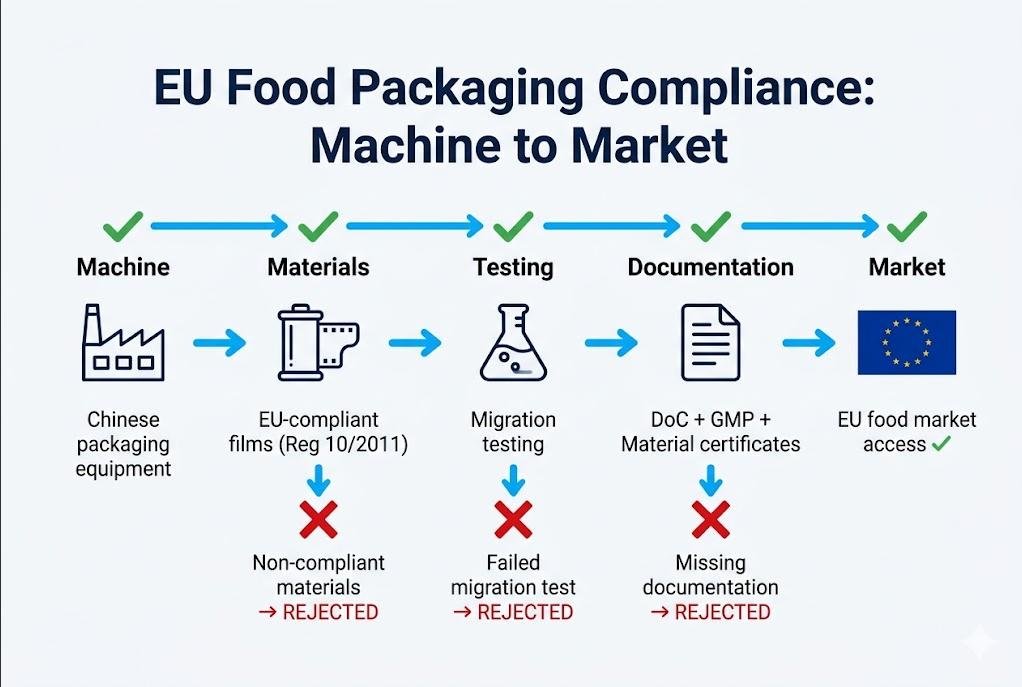
Buying packaging machinery from China to produce food-contact materials for EU markets isn’t just about finding the lowest price or the fastest delivery. It’s about buying equipment that can actually deliver products that meet EU food safety regulations — and if the machine can’t do that, it doesn’t matter how good the price was.
EU Regulation 1935/2004 and the associated framework (Regulation 2023/2006 on Good Manufacturing Practice, plus material-specific measures like the Plastics Regulation 10/2011) set strict requirements for any material or article intended to come into contact with food. That includes packaging film, bottles, caps, labels, seals — anything that touches food during production, storage, transport, or consumption.
The machine itself isn’t directly regulated, but the products it makes are. And if your Chinese-made form-fill-seal machine, bottle filler, or sealing equipment produces packaging that leaches chemicals, fails migration testing, or doesn’t have the right documentation, your product gets pulled from shelves, your importer faces fines, and your business loses EU market access.
For machinery buyers sourcing equipment from China for EU food packaging applications, compliance isn’t an afterthought — it’s the starting point. Here’s what EU food-contact compliance actually means, what your machine supplier needs to deliver, and where the gaps typically appear when Chinese equipment meets European regulatory reality.
What EU food-contact compliance requires
1. The packaging material must not transfer harmful substances to food
This is the core principle: materials in contact with food must not transfer their constituents to food in quantities that could endanger human health, change the composition of the food unacceptably, or deteriorate the taste and odor.
Migration testing is how this is verified. A sample of the packaging material is placed in contact with food simulants (liquids that mimic different food types — water, acid, alcohol, oil) under defined conditions (time, temperature), and then the simulant is analyzed for transferred substances.
EU limits are strict:
- Overall migration limit: max 10 mg of total substances per dm² of packaging surface (or 60 mg/kg of food simulant).
- Specific migration limits (SML) for individual substances listed in the Plastics Regulation — some are tightly restricted (e.g., bisphenol A has an SML of 0.05 mg/kg).
If your packaging fails migration testing, it can’t be sold in the EU. Period.
2. Only authorized substances can be used in food-contact materials
The EU maintains a “positive list” of authorized substances for plastic food-contact materials (Annex I of Regulation 10/2011). If a substance isn’t on the list, it can’t be used — even if it’s safe.
This creates problems for Chinese suppliers who use additives, stabilizers, or processing aids that are common in China but not EU-authorized. A Chinese film supplier might use a perfectly safe plasticizer that’s approved in China and the US, but if it’s not on the EU positive list, the packaging is non-compliant.
3. The manufacturer must have a Declaration of Compliance (DoC)
Every batch of food-contact material must be accompanied by a written Declaration of Compliance stating that the product meets EU requirements. The DoC must include:
- Identity of the material/article
- Statement of compliance with relevant regulations
- Information on substances subject to restrictions (if applicable)
- Specifications for use (temperature, contact time, food type)
The supplier (in China) issues the DoC. The importer (in the EU) must hold it and provide it to authorities on request. If there’s no DoC, or the DoC is incomplete or inaccurate, the product is considered non-compliant.
4. Good Manufacturing Practice (GMP) must be followed
Regulation 2023/2006 requires food-contact material manufacturers to implement a quality management system that ensures materials are consistently produced in compliance with regulations.
This includes:
- Documentation of raw materials and suppliers
- Process control and quality assurance procedures
- Traceability systems
- Staff training on food safety requirements
GMP isn’t a certification you get — it’s a system you implement and document. EU authorities can audit manufacturers (including Chinese factories exporting to the EU) to verify GMP compliance.
How this applies to packaging machinery from China
The machine itself doesn’t need to be “EU certified” in the sense of food-contact compliance — but the materials it processes and the products it produces do.
Here's where machinery buyers need to focus:
1. Material compatibility: Can the machine handle EU-compliant materials?
Some Chinese packaging machines are designed around materials (films, adhesives, inks) that are common in the Chinese market but don’t meet EU food-contact requirements.
Example: A Chinese form-fill-seal machine might be optimized for BOPP film with a specific plasticizer that’s not EU-approved. If you try to run EU-compliant film (which uses a different plasticizer or no plasticizer), the sealing temperature, tension settings, or film tracking might not work properly.
Before you buy, confirm with the machine supplier:
- What film types, thicknesses, and material compositions have been successfully tested?
- Can the machine run films that meet EU Regulation 10/2011 (for plastics)?
- Are sealing bars, rollers, and other contact parts made from food-grade materials?
2. Sealing integrity: Does the machine produce reliable seals that pass EU testing?
A poorly sealed package can allow contamination, oxygen ingress, or moisture migration — all of which are food safety issues.
EU standards for packaging integrity aren’t explicitly defined in Regulation 1935/2004, but they’re implied: the packaging must protect the food from contamination and deterioration. If your machine produces inconsistent seals (weak spots, incomplete seals, seal defects), the packaging doesn’t meet its intended function.
Migration testing won’t catch this — but shelf-life testing, microbial testing, and real-world distribution will. And when a batch of food products spoils because of packaging failure, the cost (recalls, lost sales, reputational damage) is far higher than the machinery savings.
Planning to buy this equipment? Tell us your capacity and budget — we reply within 24 hours.
Get a factory-direct quote on WhatsAppBefore you buy, ask the supplier:
- What seal strength testing has been done?
- Can the machine maintain seal quality across production speed variations?
- What quality control features are built in (vision inspection, seal monitoring, reject systems)?
3. Material contact parts: Are machine components that touch packaging food-safe?
Parts of the machine that contact the packaging material (sealing bars, conveyor belts, guide rollers, cutting blades) must be made from materials that don’t contaminate the packaging.
EU GMP (Regulation 2023/2006) requires that equipment used in the production of food-contact materials is “suitable and kept clean” and doesn’t present a contamination risk.
Stainless steel is generally safe. Some plastics and rubbers are fine if they’re food-grade. But if your Chinese machine has sealing bars coated with a non-food-grade PTFE, or conveyor belts made from recycled rubber that could leach contaminants, those components could transfer substances to the packaging — and from there to the food.
Before you buy, confirm:
- Are all material-contact parts made from food-grade materials?
- Can the supplier provide material certificates or compliance declarations for contact parts?
- If you need to replace parts (sealing bars, belts, rollers), are food-grade replacements available?
The gaps that appear when Chinese machinery meets EU compliance
Gap 1: Supplier doesn't understand EU requirements
Many Chinese packaging machine manufacturers have deep experience selling into markets where food-contact regulations are less strict (Middle East, Africa, parts of Asia) or where enforcement is inconsistent. They may genuinely not understand what EU compliance requires.
A salesperson might say “yes, the machine is food-grade” when what they mean is “the machine is made of stainless steel and looks clean,” not “the machine has been validated to produce packaging that passes EU migration testing.”
Gap 2: Machine works with Chinese materials but not EU-compliant materials
A machine optimized for Chinese-market film formulations (different plasticizers, different slip agents, different thickness tolerances) may not run smoothly with EU-compliant films.
This usually shows up during commissioning: the film doesn’t track properly, seals are weak or inconsistent, or production speed has to be reduced. The supplier’s response is often “you’re using the wrong film,” but from your perspective, you’re using the compliant film — which is the only film you’re allowed to use in the EU.
Gap 3: Documentation is missing or incomplete
Chinese suppliers are used to providing CE marking documentation for machine safety (Machinery Directive 2006/42/EC), but food-contact compliance documentation is different.
You need:
- Material certificates for contact parts (sealing bars, belts, rollers)
- Confirmation that the machine doesn’t introduce non-compliant substances during processing
- Guidance on what packaging materials are compatible with the machine
Most Chinese suppliers don’t provide this unless you explicitly ask — and even then, the documentation may be generic, incomplete, or based on Chinese standards rather than EU regulations.
What to do before you buy
1. Specify EU compliance requirements in the purchase contract
Don't assume the supplier knows what you need. Be explicit:
- “The machine must be capable of processing packaging films that comply with EU Regulation 10/2011.”
- “All material-contact parts must be made from food-grade materials with supporting documentation.”
- “The supplier must provide guidance on compatible materials and quality control procedures to ensure packaging meets EU migration limits.”
2. Request material certificates for contact parts
Ask for documentation showing that sealing bars, belts, rollers, and other contact parts are food-grade. Acceptable evidence:
- Material safety data sheets (MSDS) showing composition
- Declarations of Compliance for materials (if applicable)
- Third-party certification (e.g., FDA, BfR, or equivalent food-contact approval)
If the supplier can’t provide this, that’s a red flag.
3. Test with EU-compliant materials before full production
During the factory acceptance test (FAT) or commissioning, run the machine with the actual film or packaging material you’ll use in production — not a generic Chinese-market material.
Verify:
- Film tracking and tension control work properly
- Seals are strong and consistent
- Production speed meets your requirements without compromising quality
If the machine struggles with EU-compliant materials, renegotiate or walk away.
4. Work with a lab to validate packaging compliance
Once the machine is running, send packaging samples to an EU-accredited lab for migration testing. This confirms that the packaging produced by the machine meets EU limits.
Labs in Germany (e.g., Fraunhofer IVV), Italy, or the Netherlands offer migration testing services. Cost: €500–€2,000 per test depending on scope.
If the packaging fails, you need to identify the source (material formulation, machine contamination, process conditions) and fix it before you can sell into the EU.
What we do at Zhenbao Trade
We help buyers source packaging machinery from China for EU food applications — and we help them navigate the compliance gap between Chinese manufacturing standards and EU food-contact requirements.
That includes:
- Machinery supplier vetting — connecting buyers with Chinese suppliers who understand EU compliance and have a track record of delivering machines that work with EU-approved materials.
- Specification and contracting support — helping buyers write purchase contracts that explicitly require EU compliance, including material certificates, documentation, and FAT procedures.
- Material sourcing coordination — connecting buyers with film and packaging material suppliers (in China or the EU) whose products meet Regulation 10/2011 and work with the chosen machine.
- Compliance validation support — coordinating migration testing, DoC preparation, and GMP documentation to ensure packaging produced by Chinese-made machines meets EU requirements.
Buying Chinese machinery for EU food packaging isn’t impossible — but it requires more diligence than buying for less-regulated markets. The cheapest machine that “looks food-grade” isn’t the right machine if it can’t deliver compliant packaging.
If you’re sourcing packaging equipment for EU markets, we can help you get it right.
Related Equipment
Need a price, spec sheet or a pre-shipment factory inspection? Message us directly.
Get a factory-direct quote on WhatsAppWhatsApp: +852 9702 5284 · +86 158 7238 6392