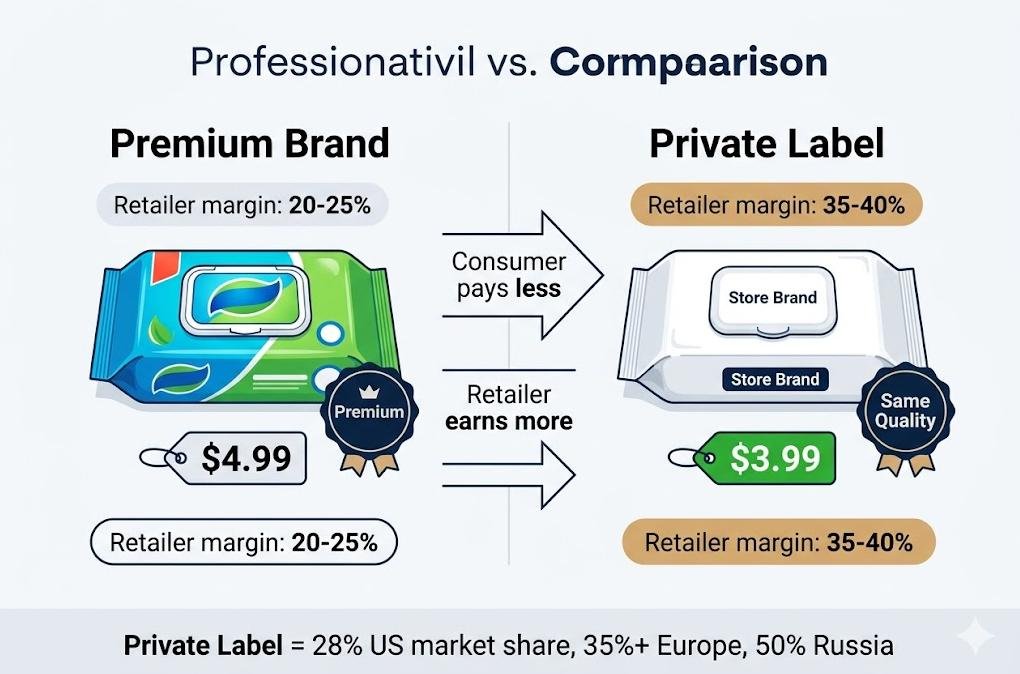
Private label wet wipes — the store-brand products sitting next to Huggies and Pampers on supermarket shelves — are quietly taking market share from established brands at a pace that’s catching even industry insiders by surprise.
In the US, private label wet wipes captured 28% of retail value sales in 2024, up from 19% in 2019. In Europe, the numbers are even higher: private label accounts for over 35% of wet wipes sales in the UK, 40% in Germany, and nearly 45% in Spain. Russia, post-sanctions, saw private label wet wipes grow from 15% to over 50% market share in just three years as Western premium brands exited.
This isn’t a temporary phenomenon driven by recession-era penny-pinching. Private label growth is structural, and it’s being driven by a combination of retailer strategy (higher margins, better supply chain control), improving product quality (the gap between private label and premium brands has shrunk dramatically), and shifting consumer attitudes (younger buyers don’t have the brand loyalty their parents did).
For manufacturers, this creates both opportunity and risk. Private label is a massive and growing market, but it’s also brutally competitive, margin-sensitive, and consolidating around a small number of large contract manufacturers who can deliver consistent quality at scale. If you’re a wet wipes manufacturer deciding whether to chase private label contracts, or a brand trying to defend against private label encroachment, understanding the economics and competitive dynamics of this shift is critical.
Here’s what’s driving private label growth, how the business model works, where the margins actually sit, and what it takes to win (or survive) in this market.
Why private label wet wipes are growing faster than branded products
1. Retailers make more money on private label than on branded goods
A retailer selling a pack of Huggies baby wipes for $4.99 typically earns a gross margin of 20–25% ($1.00–$1.25 per pack). The same retailer selling their own store-brand baby wipes for $3.99 earns a margin of 35–40% ($1.40–$1.60 per pack).
Lower retail price, higher retailer profit. That’s the magic of private label.
Retailers control the entire value chain: they set the price, they choose the manufacturer, they decide the pack size and format, and they keep the margin that would otherwise go to a brand for marketing, R&D, and overhead.
For a supermarket chain with 500 stores selling 10,000 packs of wet wipes per week, the margin difference between branded and private label is $200,000–$300,000 per year. Multiply that across baby wipes, household cleaning wipes, personal care wipes, and disinfectant wipes, and the incentive to push private label becomes obvious.
Retailers are also using private label to negotiate better terms with branded suppliers. “Give us a lower wholesale price, or we’ll give your shelf space to our private label product” is a common tactic. Brands that don’t play ball lose visibility.
2. The quality gap has closed
Ten years ago, private label wet wipes were noticeably worse than premium brands. Thinner substrate. Harsher formulation. Inconsistent sealing. Cheap packaging.
That’s no longer true. Today’s private label wet wipes are manufactured on the same equipment, using similar raw materials, by the same contract manufacturers who produce branded products. In many cases, the only difference is the label.
A European retailer’s private label baby wipes might be made by the same Italian contract manufacturer that produces a premium brand’s product — using the same nonwoven fabric supplier, the same lotion formulation (with minor tweaks), and the same sealing and packaging process. The retailer’s version sells for 30% less, not because it’s lower quality, but because there’s no brand marketing cost baked into the price.
Consumers have figured this out. Blind taste tests and product comparisons consistently show that most people can’t tell the difference between private label and premium wet wipes. Once that perception gap closes, price becomes the deciding factor.
3. Younger consumers don't have brand loyalty
Millennials and Gen Z buyers are less loyal to established hygiene brands than their parents were. They’re more willing to try private label, more skeptical of brand marketing claims, and more price-sensitive (especially for commodity products like wet wipes where differentiation is hard to perceive).
A 2024 consumer survey in the US found that 62% of buyers under 35 said they’d switched to private label wet wipes in the past two years, compared to 38% of buyers over 50. The reasons: “same quality, lower price” and “I don’t see the point of paying for a brand name.”
This generational shift is durable. Once a consumer switches to private label and has a good experience, they rarely switch back to premium brands unless there’s a meaningful quality or feature difference.
4. E-commerce has made private label more visible and accessible
In a physical store, shelf space is limited and premium brands often get the best positions (eye level, endcaps, promotional displays) because they pay for it. Private label is usually on the bottom shelf or tucked away.
Planning to buy this equipment? Tell us your capacity and budget — we reply within 24 hours.
Get a factory-direct quote on WhatsAppIn e-commerce, there’s no “bottom shelf.” Private label products appear in search results right next to premium brands, and consumers can easily compare price, reviews, and features. Amazon’s own-brand wet wipes (Amazon Elements, Solimo) rank at the top of search results for “baby wipes” and “disinfectant wipes” — not because they’re better, but because Amazon controls the algorithm and has an incentive to promote its own products.
Retailers with strong e-commerce platforms (Walmart, Target, Tesco, Carrefour) are doing the same thing: boosting visibility for private label products in ways they can’t do as aggressively in physical stores.
The economics of private label manufacturing
Who makes private label wet wipes?
Private label wet wipes are manufactured by contract manufacturers — companies that don’t own consumer-facing brands but produce products for retailers, distributors, and smaller brands under their labels.
The market is consolidating around a relatively small number of large players who can meet the volume, quality, and compliance requirements that major retailers demand. In Europe, companies like Tzmo (Poland), Corman (Belgium), and Fater (Italy) produce millions of private label wet wipes annually. In the US, manufacturers like Rockline Industries and PDI dominate. In China, manufacturers like Baoshengyuan and Winner Medical serve both domestic and export private label markets.
What margins do contract manufacturers earn?
Private label is a low-margin, high-volume business. A contract manufacturer producing wet wipes for a major retailer might earn a gross margin of 15–20% (compared to 30–40% for a premium branded manufacturer), but they make up for it with volume and operational efficiency.
A factory running three 8-hour shifts, six days a week, producing 200,000 packs per day for a single retailer contract can generate $50–$80 million in annual revenue. At a 15–18% margin, that’s $7.5–$14 million in gross profit — thin on a per-unit basis, but meaningful at scale.
The catch: if you lose the contract (because the retailer switches to a cheaper supplier, or brings production in-house, or renegotiates terms), your factory sits idle and your fixed costs kill you. Contract manufacturers live and die by their ability to secure long-term, high-volume contracts with creditworthy buyers.
What do retailers look for in a private label supplier?
- Consistent quality at scale — a retailer selling 10 million packs per year can’t tolerate batch-to-batch variation or supply disruptions.
- Regulatory compliance — the supplier must handle all testing, certification, and documentation required for the retailer’s markets (FDA in the US, Cosmetics Regulation in the EU, etc.). The retailer doesn’t want to own that complexity.
- Flexible pricing — retailers expect annual cost reductions as raw material prices fluctuate or as the supplier’s efficiency improves. If you can’t deliver that, the contract goes to someone who can.
- Fast turnaround on new SKUs — retailers constantly test new formats, fragrances, pack sizes. A supplier who takes six months to launch a new SKU loses to one who can do it in six weeks.
The risks and challenges of private label manufacturing
1. You're competing on price, and price only
Private label buyers don’t care about your brand, your story, or your innovation. They care about cost per unit, lead time, and quality consistency. If a competitor can deliver the same product 5% cheaper, you lose the contract.
This creates a race to the bottom that squeezes margins and rewards the most operationally efficient manufacturers — usually the largest ones with the best raw material pricing, the most automated equipment, and the lowest overhead.
2. You have no pricing power
A branded manufacturer can raise prices if raw material costs go up, and retailers have to accept it (or delist the product, which hurts their sales). A private label manufacturer has no such leverage. If your costs go up, you either absorb the hit or lose the contract.
3. Retailers can (and do) switch suppliers easily
Wet wipes are a commodity product. If a retailer’s private label baby wipes are currently made by Manufacturer A and Manufacturer B offers a 10% cost reduction with equivalent quality, the retailer will switch. There’s no brand equity, no consumer loyalty, no switching cost.
This makes private label contracts inherently unstable. A manufacturer might have a five-year agreement, but if market conditions change or a cheaper competitor emerges, the retailer will renegotiate or exit.
4. Retailers are bringing production in-house
Some large retailers (especially in Europe) are investing in their own manufacturing capacity for private label products. Lidl and Aldi both own or co-own wet wipes production facilities. This vertical integration cuts out the contract manufacturer entirely and gives the retailer even more margin.
For contract manufacturers, this is an existential threat. If your largest customer decides to build their own factory, your revenue disappears overnight.
Should you chase private label contracts?
Private label makes sense if:
- You can achieve operational excellence at scale — your factory runs efficiently, your reject rates are low, and your cost structure is lean enough to be profitable at thin margins.
- You have strong relationships with major retailers — winning a contract with Walmart, Tesco, or Carrefour requires trust, compliance capability, and a track record.
- You can absorb volume volatility — retailers adjust orders based on sales, and you need enough financial cushion to handle a 20–30% swing in monthly volume without going underwater.
Private label probably doesn't make sense if:
- You’re a small or mid-sized manufacturer without the scale to compete on price.
- You can’t invest in the automation and process control needed to hit the quality consistency retailers demand.
- You’re better suited to niche markets, premium products, or direct-to-consumer sales where you can command higher margins.
What we do at Zhenbao Trade
We help manufacturers evaluate whether private label contracts are a good fit for their business, and we connect contract manufacturers with retailers and distributors looking for reliable private label suppliers.
That includes:
- Market entry strategy for private label — helping manufacturers understand what it takes to win contracts with major retailers, what compliance and quality standards apply, and what margins are realistic.
- Retailer and distributor introductions — connecting contract manufacturers with buyers actively looking for private label wet wipes suppliers in target markets (Europe, US, Middle East, Russia).
- Machinery and process optimization — advising on equipment upgrades, automation, and process improvements that reduce cost-per-unit and improve consistency (the two things that matter most in private label).
Private label is growing, and it’s not going away. But it’s also a tough business with thin margins, intense competition, and powerful buyers. Winning requires scale, efficiency, and the ability to operate on someone else’s terms.
If you’re thinking about private label, we can help you figure out if it’s the right move — and if it is, how to position yourself to win.
Related Equipment
Need a price, spec sheet or a pre-shipment factory inspection? Message us directly.
Get a factory-direct quote on WhatsAppWhatsApp: +852 9702 5284 · +86 158 7238 6392