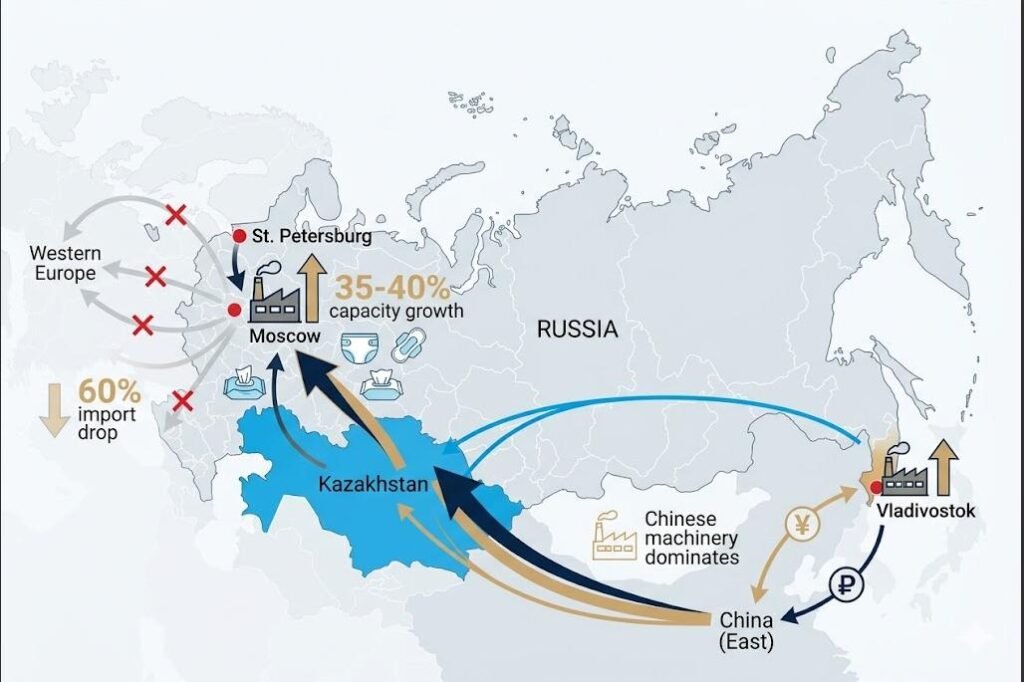
Russia’s hygiene manufacturing sector has quietly undergone one of the fastest capacity expansions of the past three years — driven not by export ambition, but by necessity.
Between 2022 and 2025, domestic production of wet wipes, sanitary pads, diapers, and tissue products in Russia grew by an estimated 35–40%, while imports from Western Europe dropped by over 60%. Brands that dominated Russian retail shelves — P&G, Kimberly-Clark, Essity — either exited the market entirely or drastically scaled back operations after sanctions made cross-border payments, logistics, and IP licensing untenable.
The gap was filled by a combination of Russian-owned manufacturers ramping up existing capacity, new entrants building greenfield factories, and a wave of Chinese and Turkish machinery imports that replaced European equipment lines. What started as crisis-driven import substitution is now becoming a durable shift: Russia is building a self-sufficient hygiene manufacturing base that doesn’t depend on Western supply chains, Western brands, or Western equipment suppliers.
If you’re a machinery supplier, a raw material vendor, or a brand considering Russia as a market or production base in 2026 and beyond, the landscape has fundamentally changed. Here’s what’s driving the shift, what challenges Russian manufacturers are navigating, and where the opportunities and risks sit for foreign suppliers working with this market.
What’s driving Russia’s hygiene manufacturing expansion
1. Import collapse created a structural supply gap that local manufacturers had to fill
Before 2022, roughly 40–50% of hygiene products sold in Russia were imported or produced locally by Western multinationals using imported components and Western-owned IP. P&G operated factories in Russia producing Pampers and Always. Kimberly-Clark had local production for Huggies. Essity (owner of Tena, Libero, and Tork brands) had manufacturing and distribution infrastructure across the country.
When sanctions hit and Western brands began exiting, the supply gap appeared almost immediately. Retailers had shelf space to fill, consumers still needed diapers and sanitary pads, and distributors were scrambling to find alternatives.
Russian manufacturers who had been operating in the mid-market segment (selling cheaper alternatives to premium Western brands) suddenly had access to shelf space, distribution partnerships, and consumer attention that had been locked up by multinationals for decades. Companies like Bella (sanitary pads and diapers), Sunny (baby care), and Mimi (wet wipes and tissues) scaled up production as fast as they could buy machinery and raw materials.
New entrants followed. Entrepreneurs who had run paper mills, packaging companies, or garment factories saw an opportunity and started building hygiene production lines. The Russian government supported this with subsidized loans, import duty exemptions on machinery (if the equipment had no domestic equivalent), and preferential procurement contracts for domestic producers.
2. Chinese machinery suppliers replaced European equipment providers almost overnight
Before sanctions, Russian hygiene manufacturers buying new production lines typically chose European equipment — Italian tissue machines, German diaper lines, Swedish wet wipes equipment. European machinery was expensive, but it came with the assumption of reliability, after-sales support, and spare parts availability.
That supply chain collapsed. European manufacturers couldn’t ship to Russia due to export restrictions. Payment was impossible. Service contracts were terminated.
Chinese suppliers stepped in immediately. Wet wipes machines, diaper production lines, sanitary pad equipment, tissue converting machines — Chinese manufacturers had been selling into Russia for years (mostly to smaller regional players who couldn’t afford European equipment), but after 2022 they became the dominant suppliers across all market segments.
A Russian manufacturer we work with ordered three wet wipes lines in 2023 from a Guangdong supplier, paid in RMB via a Chinese bank, and had the machines shipped through Kazakhstan to avoid direct logistics restrictions. The machines were commissioned by Chinese engineers who flew in on 90-day business visas. Spare parts are stocked in a bonded warehouse in Vladivostok and shipped domestically when needed.
This isn’t a temporary workaround. It’s the new normal. Russian manufacturers have accepted that Chinese equipment is their primary option, and most have been surprised that quality and reliability are better than they expected — not as polished as premium European machines, but good enough, and at 40–60% of the price.
3. Raw material supply chains have partially localized, but import dependency remains high
Hygiene manufacturing depends on nonwoven fabric, superabsorbent polymers (SAP), adhesives, and packaging film. Russia produces some of these domestically, but not at the scale or quality needed to support a large hygiene industry.
Nonwoven fabric: Russia has some domestic production (mostly for industrial and medical applications), but capacity is limited. Most nonwoven fabric for hygiene products is now imported from China, Turkey, and Central Asian suppliers.
SAP (the polymer that makes diapers and sanitary pads absorbent): Russia has almost no domestic production. Before sanctions, SAP was imported from Germany, Japan, and the US. Now it comes from China (primarily) and some from South Korea and India. Price and lead times have increased, but supply hasn’t been cut off.
Adhesives and packaging film: Some domestic production, but quality and consistency are inconsistent. Most manufacturers still import from China or Turkey.
The Russian government has announced plans to build domestic SAP production capacity and expand nonwoven fabric production, but these are multi-year projects. In the short to medium term, Russian manufacturers remain import-dependent — just on different suppliers than before.
Planning to buy this equipment? Tell us your capacity and budget — we reply within 24 hours.
Get a factory-direct quote on WhatsApp4. Government support and protectionism are accelerating the shift
The Russian government views domestic hygiene manufacturing as strategic — not just for economic reasons, but because sanitary products, diapers, and medical hygiene supplies are essential goods that a country shouldn’t be dependent on imports for.
Policy support includes:
- Subsidized loans for domestic manufacturers expanding capacity (interest rates 5–7% vs market rates of 15–18%).
- Import duty exemptions on machinery and equipment that has no domestic equivalent.
- Preferential procurement for government contracts (hospitals, schools, military) that favor domestic producers over imports.
- Simplified certification for domestic products (faster approval timelines compared to imported goods).
Some of this is protectionism that will distort the market in ways that hurt efficiency, but it’s also creating real investment and capacity expansion that wouldn’t have happened otherwise.
The challenges Russian manufacturers are navigating
1. Payments and currency risk
Western sanctions make cross-border payments extremely difficult. Russian banks are cut off from SWIFT, so payments to Chinese or Turkish suppliers typically go through intermediary banks in Central Asia, the UAE, or Hong Kong. This adds time (payments that used to take 2–3 days now take 1–2 weeks), cost (intermediary fees), and risk (accounts get frozen, transfers get rejected).
Currency volatility is another issue. The ruble has been unstable, which makes planning difficult for manufacturers who buy machinery and raw materials in RMB or USD but sell domestically in rubles.
2. Logistics and lead times
Direct shipping from China to Russia’s western ports (where most factories are located) is complicated by sanctions on shipping lines and restrictions on certain categories of goods. Most shipments now go through Kazakhstan or other Central Asian transit points, which adds 2–4 weeks to delivery times.
Air freight is expensive and unreliable. Sea freight through Vladivostok works for eastern Russia but doesn’t help manufacturers in Moscow or St. Petersburg.
3. Technical support and spare parts
European machinery suppliers used to provide on-site service, stock spare parts locally, and train operators in-country. That infrastructure is gone.
Chinese suppliers offer technical support, but it’s less mature. Engineers fly in for commissioning and initial training, but ongoing support is often remote (video calls, email). Spare parts are available but lead times are longer because there’s no established local distribution network yet.
Russian manufacturers are learning to be more self-sufficient — training their own technicians, stocking more spare parts, and building relationships with Chinese suppliers who are willing to provide faster support.
4. Quality and consistency challenges
Scaling up production fast means quality control suffers. Russian manufacturers are learning how to run new equipment, train new operators, and maintain consistency — but there’s a learning curve.
Consumers have noticed. Some domestic products are as good as the Western brands they replaced. Others are noticeably worse (thinner materials, inconsistent sealing, packaging defects). Over time, quality will improve as manufacturers gain experience and invest in better equipment and training, but in the short term, there’s a quality gap.
Opportunities for foreign suppliers
For machinery suppliers (especially Chinese manufacturers):
Russia is one of the fastest-growing markets for hygiene machinery right now. Demand is high, competition from European suppliers is gone, and Russian buyers are actively looking for reliable Chinese partners.
What Russian buyers need:
- Flexible payment terms (LC through intermediary banks, or payment in RMB).
- Fast commissioning and training (Russian operators are less experienced than Chinese operators, so training needs to be thorough).
- Spare parts logistics (either stock in Russia, or fast shipping through Kazakhstan/Vladivostok).
- Remote technical support (Russian buyers expect video support and phone troubleshooting).
For raw material suppliers:
Russia’s raw material import dependency creates opportunities for suppliers in China, Turkey, Central Asia, and India who can navigate the payment and logistics challenges.
Nonwoven fabric, SAP, adhesives, packaging film — demand is growing, and Russian manufacturers are willing to work with suppliers who can offer competitive pricing, reliable delivery, and flexible payment.
For brands and contract manufacturers:
Russia’s domestic market (145 million people, rising demand for hygiene products as incomes recover) is now largely served by Russian-owned brands. Western brands have exited or scaled back, which creates space for new entrants — especially private-label products or brands from non-Western countries (China, Turkey, India) that don’t face the same political and payment constraints.
Risks to be aware of
Sanctions risk: Western companies face legal and reputational risks doing business in Russia. Even non-Western companies (Chinese, Turkish, Indian suppliers) face secondary sanctions risk if they’re seen as helping Russia circumvent restrictions.
Payment risk: Cross-border payments are slow, expensive, and unreliable. Accounts get frozen. Transfers get rejected. Contracts that depend on timely payment are riskier than they used to be.
Geopolitical risk: The war in Ukraine is ongoing, and the sanctions environment could get stricter. A supplier building a long-term relationship with a Russian client is making a bet that the current situation is stable enough to operate in — and that bet may not hold.
What we do at Zhenbao Trade
We help Russian manufacturers source hygiene machinery and raw materials from China, and we help Chinese suppliers navigate the payment, logistics, and technical support challenges of working with Russian buyers.
That includes:
- Machinery sourcing and supplier vetting — connecting Russian buyers with Chinese wet wipes, diaper, sanitary pad, and tissue equipment suppliers who understand the Russian market and are willing to work within the payment and logistics constraints.
- Payment facilitation — coordinating cross-border payments through intermediary banks and currency exchange structures that work within the current sanctions environment.
- Logistics coordination — arranging shipments through Kazakhstan or Vladivostok, managing customs clearance, and ensuring machinery arrives on time.
- Technical support — coordinating commissioning visits, training, and ongoing remote support between Chinese engineers and Russian factory teams.
Russia’s hygiene manufacturing expansion is real and durable. Import substitution isn’t going to reverse when sanctions lift (if they ever do) because the infrastructure, the brands, and the supply chains are being built now, and they’ll be sticky.
If you’re a supplier considering Russia as a market, the opportunities are significant — but so are the risks. We help clients navigate both.
Related Equipment
Need a price, spec sheet or a pre-shipment factory inspection? Message us directly.
Get a factory-direct quote on WhatsAppWhatsApp: +852 9702 5284 · +86 158 7238 6392