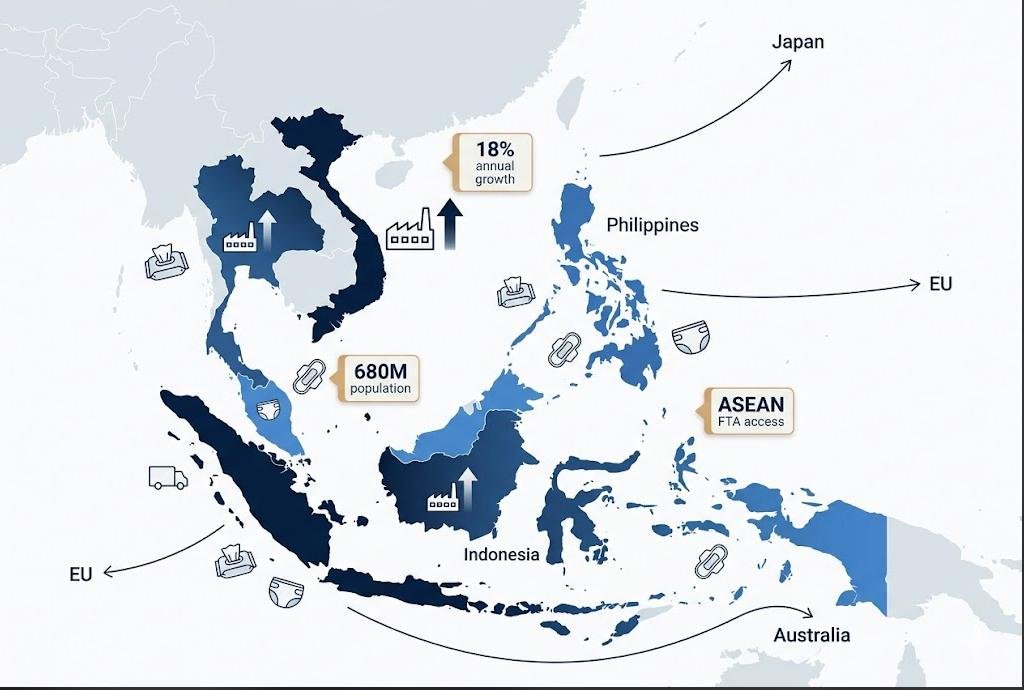
Southeast Asia is quietly becoming one of the world’s fastest-growing hygiene manufacturing hubs — and for the first time in decades, it’s not because labor is cheap.
Vietnam, Indonesia, Thailand, and the Philippines are seeing a surge in wet wipes, sanitary pad, diaper, and tissue production capacity — not just contract manufacturing for Western brands, but locally owned factories building for regional markets. Between 2020 and 2025, hygiene product manufacturing capacity in Southeast Asia grew by an estimated 18% annually, outpacing China’s growth rate (6%) and nearly matching India’s (21%).
If you’re a machinery buyer, a brand looking to diversify away from China, or a manufacturer planning where to build your next line, Southeast Asia is worth serious attention. But the opportunity is more nuanced than “China +1 arbitrage.” The region’s advantage isn’t just cost — it’s a combination of rising domestic demand, improving infrastructure, trade-agreement access, and a regulatory environment that’s maturing fast enough to attract serious investment but not so rigid that it chokes speed to market.
Here’s what’s driving the shift, what the risks are, and how manufacturers and buyers should think about Southeast Asia as a production base in 2026 and beyond.
The macro forces reshaping hygiene production in Southeast Asia
1. Domestic consumption is exploding, and local supply can't keep up
Southeast Asia’s 680 million people are entering the global middle class faster than almost any other region. Disposable income is rising, urbanization is accelerating, and consumer hygiene habits are shifting from reusable cloth to single-use products.
Indonesia alone has 275 million people, 60% under the age of 40, and a GDP growth rate averaging 5% annually. Wet wipes penetration in Indonesia is still under 15% of households (compared to 65% in developed markets), but it’s growing at 12–14% per year. Sanitary pad usage is rising even faster as rural electrification and retail distribution reach previously underserved areas.
Vietnam’s middle class is projected to grow from 13 million in 2020 to 33 million by 2030. The Philippines has 115 million people and one of the youngest populations in the region. Thailand’s per-capita income is nearing $8,000 USD, and consumers are trading up from generic products to premium hygiene brands.
This creates a structural supply gap. Most hygiene products consumed in Southeast Asia today are either imported (expensive, long lead times, vulnerable to currency fluctuations) or produced by a small number of large regional players (P&G, Unicharm, Kimberly-Clark) who focus on premium segments and leave the mass market underserved.
New local manufacturers — often family-owned businesses scaling up from tissue or garment production — are filling that gap. They’re buying wet wipes lines, sanitary pad machines, and diaper equipment and targeting the 70% of the market that multinational brands aren’t prioritizing: affordable, locally branded products sold through traditional retail (small shops, street vendors, wet markets) rather than modern trade (supermarkets, e-commerce).
2. “China +1” is real, and Southeast Asia benefits more than any other region
Western and Japanese brands have spent the last five years diversifying supply chains away from China. Some of that capacity went to India, some to Mexico and Eastern Europe, but the largest beneficiary has been Southeast Asia.
Vietnam has become the go-to destination for contract manufacturing, especially for brands selling into the US (thanks to relatively favorable trade terms under bilateral agreements). Indonesia and Thailand are seeing investment from multinational hygiene brands building regional production hubs to serve ASEAN markets without the complexity of cross-border logistics.
But the real shift isn’t just Western brands moving — it’s Chinese manufacturers setting up satellite production in Southeast Asia. A Guangdong-based wet wipes producer we work with opened a factory in Vietnam in 2023 to serve European clients who wanted “Made in Vietnam” labels for tariff and optics reasons. The machinery is Chinese, the raw materials are Chinese, the management is Chinese — but the final product is Vietnamese, and that’s enough to unlock market access and price competitiveness that a Chinese-origin product no longer has.
3. Free trade agreements give Southeast Asia better market access than China
ASEAN has free trade agreements with China, Japan, South Korea, Australia, New Zealand, and India (RCEP), plus bilateral deals that reduce or eliminate tariffs on hygiene products exported to key markets.
A wet wipe manufactured in Thailand and exported to Japan faces a 0% tariff under ASEAN-Japan CEPA. The same product made in China faces 3–6% depending on classification. For a $50,000 container, that’s $1,500–$3,000 in savings — enough to offset higher production costs in Thailand and still land cheaper than a Chinese export.
Vietnam has an FTA with the EU (EVFTA) that phases out tariffs on hygiene products to 0% by 2027. A Vietnamese manufacturer exporting to Germany has a structural cost advantage over a Chinese competitor, even if the Vietnamese factory is slightly less efficient.
This isn’t arbitrage that disappears when wages rise. It’s durable market access that only improves as Southeast Asian manufacturers scale and improve quality.
4. Regulatory maturity is improving faster than expected
Five years ago, regulatory compliance in Southeast Asia was a wild west. Standards varied by country, enforcement was inconsistent, and importers had no clear path to certify that a hygiene product met local safety requirements.
Planning to buy this equipment? Tell us your capacity and budget — we reply within 24 hours.
Get a factory-direct quote on WhatsAppThat’s changing. Thailand’s FDA now has clear guidelines for wet wipes and cosmetic products. Indonesia’s BPOM (equivalent to the US FDA) has streamlined approval for hygiene imports and domestic production. Vietnam is harmonizing standards with ASEAN norms to make cross-border trade easier.
It’s not as mature as the EU or US, but it’s mature enough that a serious manufacturer can navigate it — and immature enough that speed-to-market is still measured in months, not years. For a brand launching a new product, that’s a meaningful advantage over highly regulated markets where compliance timelines can kill momentum.
The gaps and risks that haven’t been solved yet
Southeast Asia’s opportunity is real, but it’s not a drop-in replacement for China. Here’s what still doesn’t work well:
1. Raw material supply chains are thin and import-dependent
Most hygiene production depends on nonwoven fabric, superabsorbent polymers, adhesives, and packaging film — and Southeast Asia doesn’t produce enough of any of these domestically to support a large-scale hygiene industry.
Nonwoven fabric is mostly imported from China, South Korea, or Taiwan. SAP (the polymer that makes diapers and pads absorbent) comes from Japan, China, or Germany. Adhesives are imported. Packaging film is imported.
That means a “Made in Vietnam” wet wipe still has a 60–70% Chinese content in terms of raw material value. It’s not a problem for tariff classification (rules of origin are usually based on where substantial transformation happened, not where components came from), but it does mean your supply chain is still exposed to Chinese logistics, Chinese raw material price volatility, and Chinese export restrictions if geopolitics get worse.
2. Skilled labor for technical roles is scarce
Operating a wet wipes production line doesn’t require a PhD, but it does require a workforce that can read technical manuals, follow SOPs, troubleshoot machine faults, and maintain quality consistency across shifts. In China, you can hire that workforce easily because hygiene manufacturing has been a major industry for 20 years and there’s a deep labor pool of people who’ve worked on similar lines.
In Vietnam, Indonesia, and the Philippines, that labor pool is much thinner. You can hire operators, but finding a line supervisor who has run a wet wipes machine before, or a maintenance technician who understands servo motors and PLC troubleshooting, is harder. Expat Chinese or Taiwanese supervisors are common in new factories, which works but adds cost and creates dependency.
Training takes time. A new factory in Vietnam might need 6–12 months to get operators up to the efficiency and quality levels that a comparable Chinese factory hits in week one.
3. Infrastructure is better than it was, but still inconsistent
Vietnam’s ports and roads are good and improving. Thailand’s infrastructure is excellent. Indonesia’s is a mixed bag — Java is fine, but moving goods between islands is slow and expensive. The Philippines has logistics bottlenecks that drive costs up and reliability down.
Power reliability varies. In Vietnam and Thailand, you can run a 24/7 production line without worrying about outages. In parts of Indonesia and the Philippines, you need backup generators and voltage stabilizers, which add cost and complexity.
4. Tariff advantages are real, but they're not permanent
Free trade agreements are political, and politics change. ASEAN-China FTA tariff rates could be renegotiated. The US could impose tariffs on Vietnamese goods if it decides that “Made in Vietnam” products with majority-Chinese content are tariff circumvention. The EU is tightening rules of origin requirements.
A factory built in Southeast Asia purely for tariff arbitrage is making a bet that the rules won’t change in ways that destroy the economics. That’s a riskier bet than building for domestic market access, which is durable regardless of trade policy.
How manufacturers and buyers should think about Southeast Asia
If you’re a manufacturer considering where to build your next hygiene production line:
Southeast Asia makes sense if you're targeting one or more of these:
- Domestic or regional ASEAN sales — selling into Indonesia, Vietnam, Thailand, the Philippines, or neighboring markets. Local production eliminates import duties, shortens lead times, and gives you better control over distribution.
- Export to markets with favorable FTAs — Japan, Australia, South Korea, the EU (from Vietnam), or RCEP members.
- Brands or buyers who explicitly require non-China origin — even if your raw materials are Chinese, a “Made in Vietnam” label unlocks doors that “Made in China” doesn’t anymore.
Southeast Asia probably doesn’t make sense if your primary market is the US or the Middle East and you don’t have tariff pressure or origin requirements pushing you out of China. Chinese factories are still more efficient, raw materials are local, and logistics to those markets are well-established.
If you're a buyer sourcing hygiene machinery for a Southeast Asia factory:
- Expect slightly higher total project cost than China — not because machinery is more expensive (you’re probably still buying Chinese equipment), but because commissioning takes longer, spare parts logistics are more complex, and you may need to fly engineers in multiple times.
- Plan for local operator training as a separate project — don’t assume the machine supplier’s 5-day commissioning visit is enough. Budget for ongoing training and consider hiring an experienced line supervisor from China or Taiwan for the first 6–12 months.
- Confirm raw material supply before you commit to the factory location — if your nonwoven supplier is in China and your factory is in Indonesia, you’re adding 2–3 weeks to your material lead time and exposing yourself to shipping cost volatility. A factory in Vietnam (closer to Chinese ports) has better raw material logistics than one in the Philippines.
What we do at Zhenbao Trade
We help buyers and manufacturers navigate Southeast Asia market entry for hygiene production. That includes:
- Machinery sourcing and supplier vetting — connecting you with wet wipes, diaper, sanitary pad, and tissue equipment suppliers who’ve successfully commissioned machines in Southeast Asia and understand the local challenges (power quality, operator skill levels, spare parts logistics).
- Market entry strategy — advising on which country makes sense for your target market, tariff situation, and raw material supply chain.
- Local partner and factory identification — if you’re a brand looking to contract manufacture in Southeast Asia, we help you find and vet factories that can meet your quality, volume, and compliance requirements.
- Commissioning and training coordination — making sure the machine installation goes smoothly and operators are trained properly, which is harder in Southeast Asia than in China because the local support ecosystem is thinner.
Southeast Asia’s hygiene manufacturing boom is real, but it’s not automatic. The factories that succeed are the ones that plan for the infrastructure gaps, invest in training, and build for the right reasons (domestic demand, trade access, diversification) rather than chasing an arbitrage that might not last.
If you’re thinking about Southeast Asia as a production base, we can help you figure out if it’s the right move — and if it is, how to de-risk it.
Related Equipment
Need a price, spec sheet or a pre-shipment factory inspection? Message us directly.
Get a factory-direct quote on WhatsAppWhatsApp: +852 9702 5284 · +86 158 7238 6392