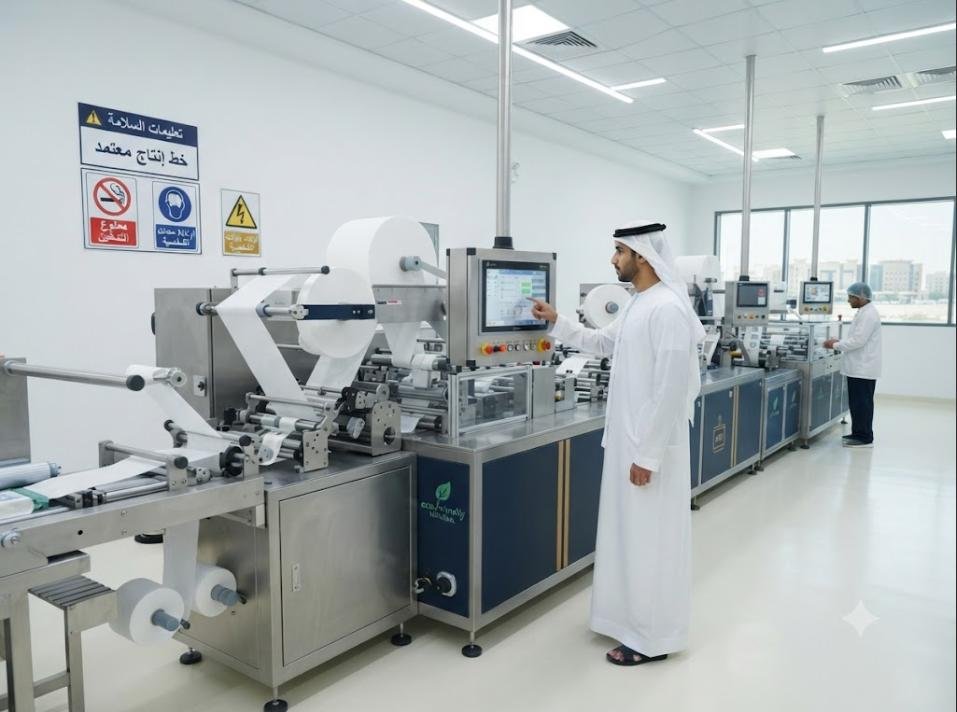
The Middle East—particularly the GCC states (UAE, Saudi Arabia, Kuwait, Qatar, Oman, Bahrain)—represents one of the fastest-growing markets for industrial machinery imports from China. But entering this market successfully requires more than competitive pricing.
After working with buyers across the Gulf region for 15 years, I’ve seen which Chinese suppliers break through and which get stuck at the inquiry stage. Here’s what you actually need to know.
Why the Middle East Matters for Machinery Exporters
The GCC countries are investing heavily in local manufacturing capacity as part of economic diversification plans (Saudi Vision 2030, UAE’s Make it in the Emirates). This creates sustained demand for:
✓ Hygiene product machinery (wet wipes, sanitary napkins, baby diapers)
✓ Food packaging equipment
✓ Beverage filling and sealing lines
✓ Non-woven fabric production systems
Unlike mature Western markets, Middle Eastern buyers often prefer turnkey production lines over individual machines—they want a supplier who can deliver, install, train, and support the entire operation.
Certification Requirements You Can't Skip
- CE Marking
Even though the GCC isn’t in the EU, many buyers require CE certification as proof of baseline safety and quality standards. Some tenders explicitly list it as mandatory. - GSO (GCC Standardization Organization) Standards
For certain product categories—especially food contact machinery and electrical equipment—you’ll need compliance with GSO technical regulations. Check the GSO online database for your HS code. - Halal Certification (for food-contact equipment)
If your machine touches food or beverage products, buyers may request confirmation that materials and lubricants are halal-compliant. Partner with a recognized halal certification body. - SABER (Saudi Arabia)
Saudi imports now require pre-shipment registration through the SABER platform. This includes a Product Conformity Certificate (PCoC) based on relevant GSO or international standards.
Without these, your machinery may get held at customs or rejected during the tender evaluation phase.
Payment Terms & Financial Expectations
Middle Eastern buyers generally have strong purchasing power, but payment structures differ from other regions:
Planning to buy this equipment? Tell us your capacity and budget — we reply within 24 hours.
Get a factory-direct quote on WhatsAppCommon payment terms:
- 30% deposit, 60% before shipment, 10% after installation
- Letter of Credit (LC) at sight or 30-60 days
- Some government buyers require performance bonds
What this means for you:
- Be ready to work with LCs—many GCC buyers prefer them over T/T
- Offer extended warranties (18-24 months) to build confidence
- Include installation, training, and spare parts in your quotation by default
Don’t try to push 100% T/T upfront. It signals inexperience in this market and will eliminate you from serious tenders.
Relationship Dynamics: What Middle Eastern Buyers Value
- Face-to-face meetings still carry weight
Video calls are fine for technical discussions, but if you’re serious about a large deal, plan to visit or invite the buyer to your factory. Middle Eastern business culture values personal trust. - Responsiveness across time zones
GCC working hours run Sunday–Thursday. If you’re only reachable during China’s business day, you’ll miss critical decision windows. Assign a contact person who can respond during Gulf working hours. - Technical competence in English and Arabic
Your sales materials, machine manuals, and HMI interfaces should offer English as standard. Arabic is a strong plus—especially for operator training and after-sales support. - After-sales infrastructure
Buyers want to know: Who will service this machine when something breaks? If you don’t have a local service partner or spare parts warehouse in the region, clearly explain your remote support and spare parts logistics. Fast shipping (DHL express for critical parts) is non-negotiable. Common Mistakes Chinese Suppliers Make
❌ Offering only FOB pricing without installation
Middle Eastern buyers often expect DDP or CIF + installation as part of the package.
❌ Ignoring spare parts in the initial quote
Always include a recommended spare parts list with pricing. Buyers want to calculate total cost of ownership upfront.
❌ Using WeChat as the primary communication tool
WhatsApp dominates business communication in the Middle East. Make sure your sales team is active and responsive there.
❌ Underestimating documentation requirements
Commercial invoice, packing list, certificate of origin, CE/GSO certificates, halal cert (if applicable), and SABER registration—get this wrong and your shipment sits at the port for weeks.
How to Position Your Offer
When you approach a Middle Eastern buyer, lead with:
- Clear compliance – State your certifications upfront (CE, GSO, halal if applicable)
- Turnkey capability – Installation, training, 18-month warranty, spare parts package
- References from the region – If you’ve delivered to UAE, Saudi, or Oman before, say so
- Responsive support – WhatsApp contact, English-speaking engineer, fast spare parts shipping
Your competitors are already doing this. If you’re not, you’re invisible.
Final Thoughts
The Middle East isn’t just another export market—it’s a relationship-driven, documentation-heavy, high-value market where the winners are suppliers who understand that service matters as much as price.
If you can demonstrate compliance, offer turnkey solutions, and stay responsive across time zones, you’ll stand out from the dozens of generic Alibaba inquiries these buyers receive every week.
Need help positioning your machinery for Middle Eastern buyers—or finding the right partners in the GCC?
We’ve been connecting Chinese suppliers with Gulf-region buyers since 2011.
📩 Get in touch: sales@zhenbaotrading.com
Related Equipment
Need a price, spec sheet or a pre-shipment factory inspection? Message us directly.
Get a factory-direct quote on WhatsAppWhatsApp: +852 9702 5284 · +86 158 7238 6392