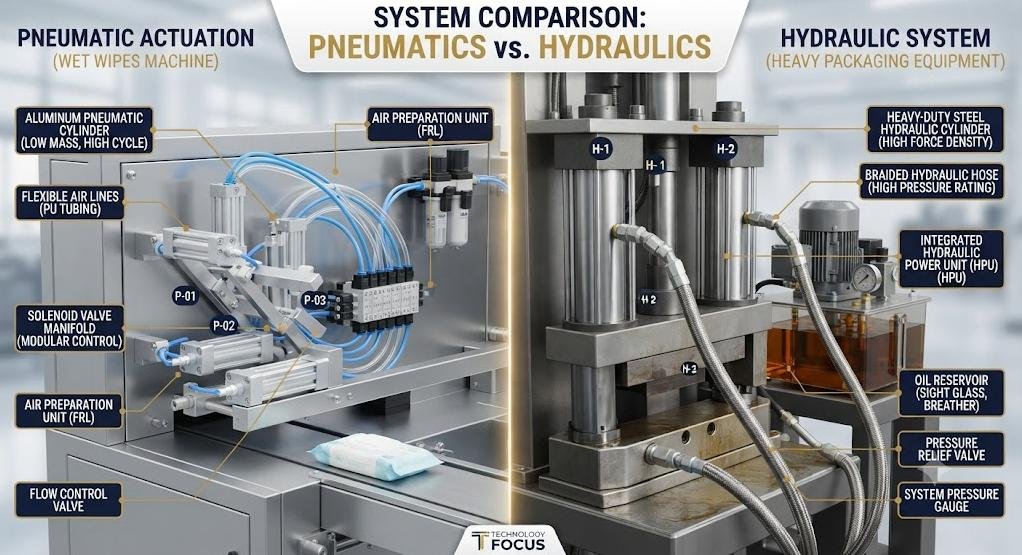
When you’re comparing packaging equipment—especially for wet wipes, food, or hygiene products—you’ll notice some machines use pneumatic (compressed air) systems, while others use hydraulic (oil-powered) systems.
The supplier might not explain the difference, but it matters. The wrong choice can cost you thousands per year in maintenance, downtime, and contamination risk.
I’ve sourced hundreds of machines over 15 years, and I’ve seen manufacturers regret both choices—usually because they didn’t understand the trade-offs upfront. Let me break it down.
The Basics: Pneumatic vs Hydraulic—What’s the Difference?
Pneumatic systems use compressed air to power cylinders, actuators, and valves.
→ You need an air compressor, air dryer, filters, and pressure regulators.
→ Air is compressible, so movements are faster but less forceful.
Hydraulic systems use pressurized oil (hydraulic fluid) to power cylinders and motors.
→ You need a hydraulic pump, oil reservoir, filters, and pressure lines.
→ Oil is incompressible, so movements are slower but much more powerful.
Quick comparison:
| Feature | Pneumatic | Hydraulic |
|---|---|---|
| Power density | Lower (good for light–medium tasks) | Higher (handles heavy loads easily) |
| Speed | Faster (air compresses, allows quick strokes) | Slower (oil is denser) |
| Force | Up to ~5,000 N typical cylinder | 50,000+ N easily achievable |
| Contamination risk | Low (air is clean if filtered) | Higher (oil leaks = product contamination risk) |
| Maintenance frequency | Moderate (seals, filters) | Higher (oil changes, seal replacements, leak monitoring) |
| Cost to operate | Higher (compressor runs continuously, air leaks waste energy) | Lower per unit force (pump runs on-demand) |
| Noise level | Louder (compressor + air exhaust) | Quieter (pump hum, no exhaust) |
| Safety | Safer (air leaks aren’t hazardous) | Oil leaks are slippery, potential fire hazard |
Now let’s get into what this means for your business.
When Pneumatic Systems Win: Packaging, Light Assembly, Food Contact
Best for:
- Wet wipes packaging machines
- Food packaging (bakery, snacks, dry goods)
- Carton sealing, case packing, palletizing (light products)
- Cosmetic filling and capping lines
Why pneumatic works here:
- Speed: Packaging lines prioritize cycle speed. Pneumatic cylinders extend and retract faster than hydraulic (50–500 mm/sec vs 10–100 mm/sec). When you’re sealing 120 wipes packs per minute, that speed gap matters.
- Clean operation: Compressed air is clean. If a pneumatic seal fails, air leaks—annoying, but not a contamination crisis. If hydraulic oil leaks near food or cosmetic products, you’ve got a recall-level problem.
- Lower upfront cost: Pneumatic machines typically cost 10–20% less than equivalent hydraulic versions, because components are simpler and cheaper.
Real example: A wet wipes machine I sourced for a Nigerian client uses pneumatic cylinders for bag feeding, sealing, and cutting. The entire machine runs on a 7.5 kW air compressor. Clean, fast, and auditable (food-safe air system). No oil near the product zone = passed GMP audit easily.
The catch—operating cost:
Compressed air is expensive. For every 1 kW of work output, you’re using 7–8 kW of compressor power (due to compression losses, leaks, and heat). If your machine runs 16 hours/day, that’s $1,500–3,000/year in wasted electricity just from air inefficiency.
But for food/hygiene products, that cost is worth avoiding contamination risk.
When Hydraulic Systems Win: Heavy Duty, High Force, Precision
Best for:
- Large carton compression (baling, waste compaction)
- Injection molding machines
- Metal forming, stamping, pressing
- High-tonnage clamping or cutting (e.g., die-cutting thick materials)
Why hydraulic works here:
- Massive force in compact size: A hydraulic cylinder can generate 50+ tons of force. A pneumatic cylinder that size would need impossibly high air pressure or be 3x larger.
- Precise force control: Hydraulic systems hold pressure steady under load—critical for molding, embossing, or compression tasks. Pneumatic systems “bounce” under load because air compresses.
- Lower energy waste if the machine only cycles intermittently: Hydraulic pumps can run on-demand. If your machine sits idle between cycles, the pump shuts off. Pneumatic compressors often run continuously to maintain system pressure (even when idle = wasted power).
The catch—maintenance complexity:
Hydraulic systems leak. Oil seals degrade faster than air seals. You’ll replace seals every 12–24 months, change hydraulic oil annually, and clean oil filters monthly. Budget $800–2,000/year in maintenance for a mid-sized hydraulic system.
And if you’re packaging food, cosmetics, or pharmaceuticals? Hydraulic oil near the product zone is a contamination risk. Auditors will flag it.
Total Cost of Ownership: The Real Decider
Let’s compare TCO over 5 years for a typical wet wipes packaging machine (hypothetical, but based on real quotes):
| Cost Factor | Pneumatic System | Hydraulic System |
|---|---|---|
| Machine purchase price | $42,000 | $48,000 |
| Air compressor / hydraulic unit | $3,500 (7.5 kW compressor) | $2,800 (hydraulic power pack) |
| Annual energy cost | $2,400/year (air inefficiency) | $1,600/year (pump runs on-demand) |
| Annual maintenance | $600/year (seals, filters) | $1,500/year (oil, seals, leaks) |
| Contamination risk mitigation | $0 (air is clean) | $800/year (extra cleaning, oil-absorbent mats, spill containment) |
| 5-year TCO | $62,500 | $64,300 |
The gap is only ~$1,800 over 5 years—but the risks differ:
- Pneumatic: Higher energy cost, but zero contamination risk.
- Hydraulic: Lower energy cost, but you’re managing oil leaks near a food-grade product.
For wet wipes, cosmetics, and food packaging, pneumatic wins because contamination risk isn’t worth the $360/year energy savings.
Planning to buy this equipment? Tell us your capacity and budget — we reply within 24 hours.
Get a factory-direct quote on WhatsAppFor heavy industrial (baling machines, metal stamping), hydraulic wins because you need the force, and there’s no food-contact concern.
Maintenance Reality: What Your Team Will Actually Do
Pneumatic maintenance (easier):
- Daily: Check for air leaks (listen for hissing), drain moisture from air tank
- Weekly: Inspect filter elements, check regulator pressure settings
- Monthly: Replace air filters, lubricate cylinders (if not self-lubricating)
- Annually: Replace cylinder seals (if wear is visible)
Hydraulic maintenance (harder):
- Daily: Check for oil leaks, inspect hoses for cracks
- Weekly: Check hydraulic fluid level, monitor pump temperature
- Monthly: Clean oil filters, check for seal wear, wipe down cylinders
- Quarterly: Sample hydraulic oil for contamination (water, particles)
- Annually: Replace hydraulic oil, replace worn seals, flush system
Which one will your team actually do?
I’ve seen factories where hydraulic machines leak for weeks because “we’ll fix it next month.” Meanwhile, pneumatic leaks get noticed immediately (they’re loud), and fixing them is cheaper (swap a $15 seal vs a $80 hydraulic seal + oil cleanup).
Contamination Risk: The Deciding Factor for Food & Cosmetics
If you’re packaging anything that goes near human skin, gets consumed, or faces GMP/HACCP audits, pneumatic is the default choice unless you absolutely need hydraulic force.
Why auditors prefer pneumatic:
- Air leaks don’t contaminate the product
- No oil-spill cleanup procedures needed
- Food-grade compressed air systems are standard and certifiable
When hydraulic is acceptable in food/cosmetic zones:
- The hydraulic unit is physically separated from the product area (e.g., in a sealed machine base, with oil-tight barriers)
- You use food-grade hydraulic fluid (NSF H1-certified)
- You have spill containment and documented cleanup SOPs
But even with those mitigations, most GMP auditors side-eye hydraulic systems near product zones. Pneumatic removes the question entirely.
Which Should You Buy?
Buy pneumatic if:
✓ Your product is food, cosmetic, or hygiene-related
✓ You need fast cycle times (>60 packs/min)
✓ Force requirements are moderate (<5,000 N per actuator)
✓ You want simpler maintenance
✓ Contamination risk is unacceptable
Buy hydraulic if:
✓ You need massive force (pressing, clamping, baling)
✓ Your product isn’t food-contact or contamination-sensitive
✓ Precision under load matters (e.g., embossing, molding)
✓ The machine cycles infrequently (so pump can shut off between cycles)
Real talk: For 90% of wet wipes, cosmetic, and light food packaging machines, pneumatic is the right call. Hydraulic only makes sense for heavy-duty industrial tasks where you can’t avoid needing the force.
How to Spec This When Sourcing from China
When you request a quote, explicitly state:
“Machine must use pneumatic actuation with food-grade compressed air system. All product-contact zones to be pneumatic only—no hydraulic oil near product. Provide compressor sizing and air consumption specs.”
If a supplier pushes hydraulic, ask:
- “Why hydraulic instead of pneumatic for this application?”
- “Is the hydraulic unit sealed away from the product zone?”
- “What’s your spill containment and cleaning SOP?”
If they can’t answer convincingly, switch suppliers.
Bottom Line
Pneumatic systems cost slightly more to run (energy), but they’re cleaner, faster, and simpler to maintain—perfect for food and cosmetic packaging.
Hydraulic systems deliver more force and can be cheaper at the power plug, but they leak, require more maintenance, and pose contamination risk.
For wet wipes, cosmetic, and hygiene product packaging: choose pneumatic unless you have a specific reason not to.
Need help sourcing pneumatic packaging equipment from China? We vet suppliers for air system design, energy efficiency, and food-grade compliance. Email us: sales@zhenbaotrading.com
Related Equipment
Need a price, spec sheet or a pre-shipment factory inspection? Message us directly.
Get a factory-direct quote on WhatsAppWhatsApp: +852 9702 5284 · +86 158 7238 6392