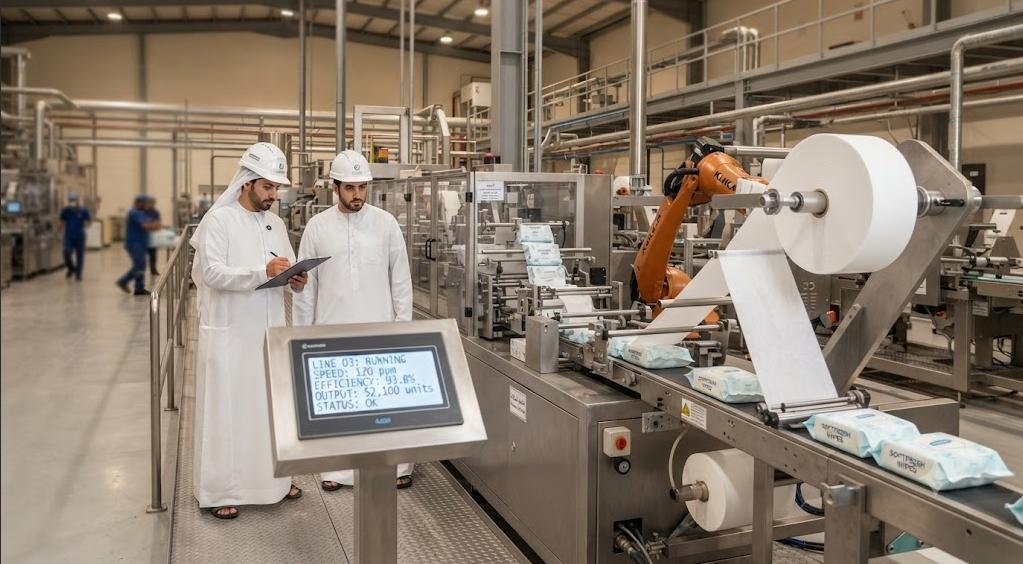
The New Equation: Why Saudi Buyers Are Rethinking Machine Specifications in 2026
If you’re importing wet wipes production equipment into Saudi Arabia this year, you’re navigating a market shaped by two concurrent realities: rising freight costs on the China-to-Jeddah lane, and the Kingdom’s aggressive push to raise local employment in procurement-adjacent roles to 70%.
That second factor—often overlooked by machinery suppliers focused purely on technical specs—has quietly become a deciding variable in equipment ROI calculations. Here’s why: when the staff managing your production floor, warehousing, and supply chain must increasingly be Saudi nationals (who command higher wages than the migrant workforce that historically dominated these roles), the payback period on labor-saving automation compresses dramatically.
This article unpacks the freight landscape, decodes the Saudization mandate that took effect May 31, 2026, and walks through a worked example showing how a fully automatic wet wipes line can now justify its premium over semi-automatic alternatives in as little as 18-24 months under the new labor cost structure—versus the 36+ months that was typical just two years ago.
Part 1: What It Actually Costs to Ship Machinery from China to Saudi Arabia Right Now
Current Freight Rates and What's Driving Them
As of the second week of July 2026, ocean freight from China’s eastern ports (Ningbo, Shanghai) to Jeddah is running at approximately $4,600–$6,500 per 40-foot container, depending on carrier, booking timing, and whether you’re shipping under a contract rate or spot market.
Here's the context behind those numbers:
- The Drewry World Container Index (WCI) closed at $4,639 per 40ft container on July 9, 2026—up 2% week-over-week and sitting at the highest level since September 2024, roughly 74% above year-ago levels. (Source: Drewry WCI, July 9, 2026)
- The Shanghai→Mediterranean lanes (which include Jeddah via Suez Canal routing) have seen sharper increases: CMA CGM announced a Far East-to-Middle East FAK rate hike to $7,900–$8,500 per 40ft effective July 15, targeting peak season demand. (Source: Container News / Drewry, July 10, 2026)
- Capacity tightness is real: carriers have blanked 46 sailings across major East-West lanes over the next five weeks (July 13–August 16), representing a 6% cancellation rate. (Source: Drewry Cancelled Sailings Tracker, July 10, 2026) The Hormuz Risk Premium You Need to Price In
Beyond base freight, there’s an insurance and security surcharge buyers should account for: tensions around the Strait of Hormuz—the narrow waterway through which much Middle East-bound cargo must pass—remain elevated. In late June 2026, a container vessel was attacked off the coast of Oman, and naval escort operations were temporarily paused. (Source: Drewry Market Commentary, July 9, 2026)
While commercial shipping has resumed, insurers have not rolled back their risk premiums, and many forwarders are building in a 7–10 day buffer on quoted lead times to account for potential re-routing via the Cape of Good Hope if Red Sea / Hormuz risks flare up again.
What this means for machinery buyers:
When your Chinese supplier quotes you CIF Jeddah, ask them how long that freight rate is locked. The volatility we’re seeing in Q3 2026 makes any quote valid for more than 7 days effectively speculative. If you’re not ready to lock your booking within a week of PI signature, ask for an FOB Ningbo price instead and arrange your own freight—at least then you control the timing and carrier selection.
A typical wet wipes production line (single-lane automatic, including peripherals like the unwinder, slitting unit, and carton sealer) will occupy most of a 40ft HC container. For a complete turnkey line with spare parts and auxiliary equipment, budget 1.5 to 2 containers. At current spot rates, that’s $7,000–$13,000 in freight alone—a line item that, two years ago, would have been $4,000–$7,000.
Part 2: The 70% Saudization Rule—What It Actually Requires and Who It Affects
The Policy in Plain Language
On May 31, 2026, Saudi Arabia’s Ministry of Human Resources and Social Development (MHRSD) raised the mandatory Saudization quota to 70% for twelve procurement-adjacent job roles in private-sector companies employing three or more people in these positions. (Source: ZAWYA / Saudi Consulate General Jeddah Economic & Commercial Office, June 2, 2026)
The twelve covered roles include:
- Procurement Manager
- Procurement Representative
- Contract Manager
- Warehouse Manager
- Warehouse Administrator
- Logistics Manager
- Tender Specialist
- Procurement Specialist
- E-Commerce Specialist
- Market Research Specialist
- Warehouse Specialist
- Private Label Supply Specialist
If your wet wipes manufacturing operation in Riyadh, Dammam, or Jeddah employs three or more people across these roles, at least 70% of those headcount slots must be filled by Saudi nationals starting from the policy’s effective date.
Why This Matters More for Production Floor Planning Than You Think
At first glance, this looks like an HR and procurement department issue—not something that changes how you spec a production line. But dig one layer deeper and the implications become clear:
Saudi nationals command significantly higher wages than the migrant labor pool that has historically staffed lower-skilled and mid-skilled roles in GCC manufacturing. As companies shift procurement, logistics, and warehouse management roles to Saudi hires to stay compliant, the total labor cost per unit produced rises—even if the production operators themselves remain non-Saudi (which is still permitted under current policy).
More importantly, companies are not just replacing existing staff—they’re often creating new roles or formalizing previously informal positions to meet the letter of the law, further expanding the wage bill.
This is where automation economics shift.
Part 3: The Automation ROI Calculation Under the New Labor Cost Reality
Scenario: Semi-Automatic vs. Fully Automatic Wet Wipes Line
Let’s compare two equipment purchasing decisions for a startup wet wipes brand in Riyadh targeting 30 packs per minute output (roughly 10 million packs per year on a two-shift operation):
| Specification | Semi-Automatic Line | Fully Automatic Line |
|---|---|---|
| Equipment cost (FOB China) | ~$85,000 USD | ~$160,000 USD |
| Freight (2 containers, July 2026 rates) | ~$10,000 USD | ~$12,000 USD (bulkier, needs more crating) |
| Customs + installation | ~$8,000 USD | ~$12,000 USD |
| TOTAL landed & installed | ~$103,000 USD | ~$184,000 USD |
| Direct operators required per shift | 5–6 people | 2 people |
| Warehouse + material handling (linked to production) | 2–3 people | 1 person |
| Estimated compliance-driven Saudi labor (procurement, logistics, QC) | 2 Saudi nationals (forced by Saudization) | 2 Saudi nationals (same) |
Monthly labor cost estimates (2026, post-Saudization):
- Migrant production operator: ~3,500 SAR/month (~$933 USD)
- Saudi warehouse/logistics role (entry-level): ~6,000–8,000 SAR/month (~$1,600–$2,133 USD)
- Saudi procurement/contract specialist (mid-level): ~10,000–14,000 SAR/month (~$2,667–$3,733 USD)
Semi-automatic line monthly labor (2-shift operation):
- 10–12 migrant operators × 3,500 SAR = 35,000–42,000 SAR
- 4–6 warehouse/material handlers (mixed) = 18,000–28,000 SAR
- 2 Saudi compliance roles (procurement/logistics) = 16,000–22,000 SAR
- TOTAL: ~69,000–92,000 SAR/month (~$18,400–$24,500 USD/month)
Fully automatic line monthly labor:
- 4 migrant operators × 3,500 SAR = 14,000 SAR
- 2 material handlers = 7,000–12,000 SAR
- 2 Saudi compliance roles = 16,000–22,000 SAR
- TOTAL: ~37,000–48,000 SAR/month (~$9,867–$12,800 USD/month)
Monthly labor savings with full automation: ~$8,600 USD (using mid-range estimates)
Payback Period
The fully automatic line costs $81,000 more upfront than the semi-automatic alternative.
Payback purely from labor savings:
$81,000 ÷ $8,600/month = 9.4 months
Even if we conservatively assume the actual monthly savings is only $6,000 (to account for overtime, turnover costs, training):
$81,000 ÷ $6,000 = 13.5 months
That's payback in just over one year—and that's before accounting for:
- Higher uptime and throughput (automatic lines typically achieve 85–90% OEE vs. 70–75% for semi-automatic)
- Lower defect rates (fewer manual touchpoints = fewer contamination or mis-seal incidents, which matter enormously in a SASO/SABER compliance environment)
- Reduced recruitment and training overhead (fewer bodies to hire, onboard, and replace when they leave)
In the pre-Saudization environment (2023–2024), when migrant labor was cheaper and more abundant, that same payback calculation stretched to 30–40 months—long enough that many buyers reasonably chose the cheaper semi-auto option and accepted the higher headcount.
Planning to buy this equipment? Tell us your capacity and budget — we reply within 24 hours.
Get a factory-direct quote on WhatsAppIn 2026, that trade-off has flipped.
Part 4: Practical Takeaways for Buyers Placing Orders in Q3–Q4 2026
- Get Your Freight Quote in Writing with a Validity Window
As outlined in Part 1, spot rates are rising and volatile. If your supplier quotes CIF, ask:
- “How many days is this freight rate guaranteed?”
- “If I sign PI this week but production finishes in 8 weeks, who bears the freight cost increase?”
Best practice: Lock in FOB pricing and book your own freight once the machines are 75% complete. Use a forwarder who can show you Drewry WCI or Freightos FBX rate history as evidence when negotiating.
- Run Your Own Labor Cost Model with 2026 Saudi Wage Floors
Don’t rely on generic “3–5 workers per line” guidance from supplier brochures. Map out:
- How many actual bodies you’ll need per shift, split by role (operator, material handler, QC, packer)
- Which roles will be forced Saudi under the 70% rule (procurement, logistics, warehouse management)
- What realistic Saudi wage ranges are in your city (Riyadh wages ≠ Jeddah wages ≠ small-city wages)
Plug those into a spreadsheet comparing semi-auto vs. full-auto labor costs over 36 months. The gap will likely be wider than you assume.
- Don’t Overlook SASO/SABER and CE Pre-Certification
Saudi customs enforces SASO/SABER compliance strictly for machinery imports. Your Chinese supplier should provide:
- CE marking (accepted as equivalent for many machinery categories)
- User manual in Arabic (or at minimum, English + Arabic safety labels)
- Voltage compatibility documentation (Saudi standard is 380V, 60Hz three-phase, but some regions still have older 50Hz infrastructure—verify your factory’s supply before ordering)
A shipment held at Jeddah Islamic Port for missing SABER documentation can sit for 2–4 weeks while you scramble for retroactive certification. That delay costs you not just demurrage fees but also lost production days you’ve already staffed and paid rent for.
- Consider Turnkey Installation + Training Packages
Given the shift toward Saudi operators and procurement staff (who may have less hands-on familiarity with Chinese-made equipment than the expatriate workforce they’re replacing), budget for on-site commissioning and training.
A good Chinese supplier will offer:
- 5–7 days of on-site installation supervision by their technician
- 3–5 days of operator training (ideally in English + Arabic, or with a translator you arrange)
- Video call support during the first 30 days of commercial production
This isn’t just a nice-to-have—it’s insurance against expensive downtime when your newly hired Saudi warehouse manager and procurement officer are still learning the equipment’s quirks.
Conclusion: Automation Is No Longer a Luxury in the Saudi Market—It’s a Compliance-Driven Necessity
The convergence of elevated freight costs (plan for $6,000–$13,000 per complete line as of July 2026) and the 70% Saudization mandate (effective May 31, 2026) has fundamentally changed the ROI math for wet wipes production equipment in Saudi Arabia.
Where a semi-automatic line might have been the prudent starter choice two years ago, the labor cost structure under Saudization now makes full automation pay for itself in 12–18 months—fast enough that even bootstrapped startups should seriously consider stretching their initial capex to buy the automatic line.
Put another way: the premium you pay for automation today is smaller than the wage premium you’ll pay every single month if you staff a semi-automatic line under the new labor policy.
If you’re evaluating suppliers and quotes right now, don’t just compare the equipment price—run the three-year total cost of ownership model with realistic 2026 Saudi labor rates. The resulting number might surprise you.
And when you’re ready to move forward, make sure your supplier locks in freight validity, confirms SASO/SABER compliance in writing, and includes on-site training. Those three details will save you more headaches than any discount on the machine itself.
FAQ: Common Questions About Importing Wet Wipes Machinery to Saudi Arabia in 2026
Q1: How long does it take to ship wet wipes machinery from China to Jeddah?
A: Sea freight transit time is typically 18–25 days port-to-port, but you should add 7–10 days buffer in Q3 2026 due to potential Hormuz / Red Sea re-routing. Total door-to-door (including customs clearance and inland transport) is usually 35–45 days.
Q2: Can I import used or refurbished wet wipes production equipment into Saudi Arabia?
A: Yes, but SASO requires additional documentation proving the equipment’s compliance with current safety standards. Customs may also require a third-party inspection report. In practice, most buyers find it simpler to import new equipment.
Q3: What’s the import duty rate on wet wipes machinery entering Saudi Arabia?
A: As of 2026, most industrial machinery (HS Code 8422 category for packaging machines) enters Saudi Arabia at a 5% customs duty rate. However, rates can vary by specific sub-classification—confirm the exact HS code with your customs broker before finalizing costs.
Q4: Does the 70% Saudization rule apply to foreign-owned factories operating in Saudi Arabia?
A: Yes. The policy applies to all private-sector entities operating in the Kingdom, regardless of ownership nationality, as long as they employ three or more people in the covered procurement, logistics, and warehouse roles.
Q5: How much should I budget for SASO/SABER certification if my supplier hasn’t already obtained it?
A: If certification needs to be obtained in-country after shipment arrival, budget $2,000–$5,000 USD and 2–4 weeks of delay. To avoid this, confirm your supplier provides CE-marked equipment with all documentation before you finalize the order.
About the Author:
Maggie (岳乙晴) | Founder & Sales Director
Zhenbao Trading Co., Ltd.
5 years of experience in cross-border machinery sourcing and B2B trade between China and Middle East / Southeast Asia markets.
Email: sales@zhenbaotrading.com
Website: zhenbaotrading.com
Sources cited:
- Drewry World Container Index, July 9, 2026
- Drewry Market Commentary (Hormuz security risk), July 9, 2026
- Container News / CMA CGM rate announcement, July 10, 2026
- Drewry Cancelled Sailings Tracker, July 10, 2026
- ZAWYA / Saudi Consulate General Jeddah (70% Saudization policy), June 2, 2026
- Hangzhou Municipal Commerce Bureau Country Briefing No. 7, July 2026
Related Equipment
Need a price, spec sheet or a pre-shipment factory inspection? Message us directly.
Get a factory-direct quote on WhatsAppWhatsApp: +852 9702 5284 · +86 158 7238 6392