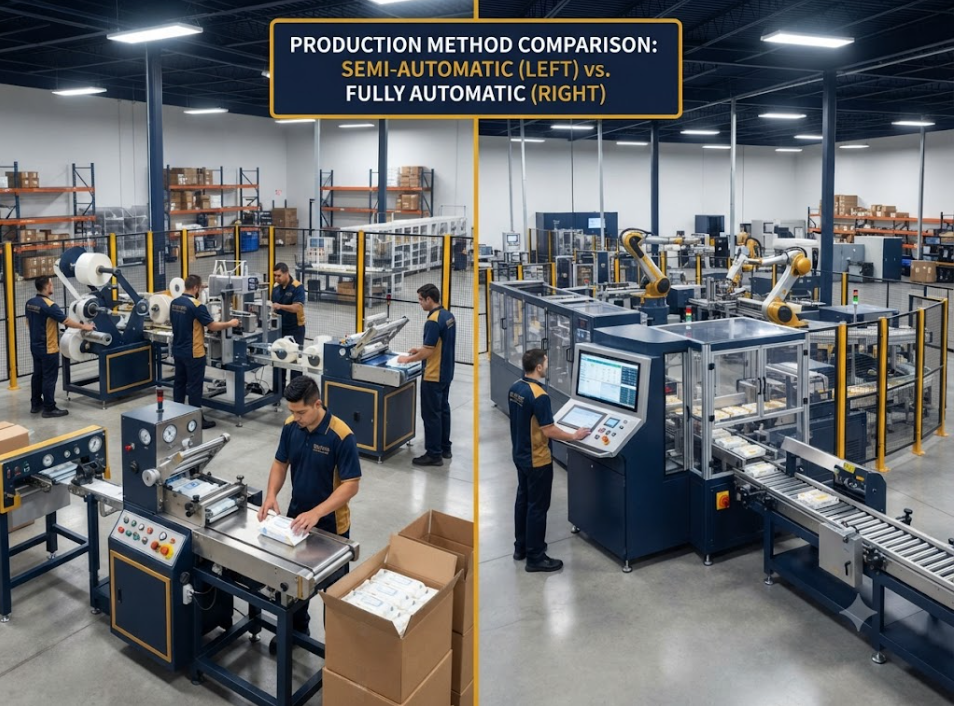
When you’re looking to start or expand your wet wipes production, one of the first questions you’ll face is whether to invest in a semi-automatic or fully automatic machine. It’s not just about budget – it’s about matching the equipment to your production goals, workforce, and growth plan.
I’ve worked with buyers across Southeast Asia, the Middle East, and Latin America who’ve made this choice. Some picked semi-auto and scaled up smoothly. Others jumped straight to full automation and hit bottlenecks they didn’t see coming. Here’s what actually matters when making this decision.
Understanding the Two Types
A semi-automatic wet wipes machine requires operator involvement at key stages – usually loading raw materials (nonwoven fabric, solution), adjusting settings, and handling packaging. Output typically ranges from 30 to 80 packs per minute, depending on the model and pack size.
A fully automatic machine handles the entire process from fabric unwinding to final packaging with minimal human input. Modern lines can produce 100 to 200+ packs per minute, with integrated quality checks and error detection.
When Semi-Auto Makes Sense
If you’re in any of these situations, semi-auto is likely your better starting point:
✓ You’re testing the market. You want to validate demand before committing to a six-figure investment. Semi-auto machines start around $15,000–$40,000, while full automation begins at $80,000 and easily exceeds $150,000 for high-speed lines.
✓ Your daily output is under 50,000 packs. At this volume, the labor cost of 2–3 operators is still lower than the financing and maintenance cost of a fully automatic line.
✓ You need product flexibility. Many buyers start with multiple SKUs – different pack sizes, formulations, or private label runs for various clients. Semi-auto machines are easier to adjust between batches without complex programming.
✓ Your workforce is readily available and affordable. In markets where skilled machine operators earn $300–$600/month, the labor cost doesn’t justify full automation yet.
When to Go Fully Automatic
Full automation becomes the right move when:
✓ You have confirmed orders or contracts that require consistent daily output above 80,000 packs. The machine pays for itself through volume efficiency.
Planning to buy this equipment? Tell us your capacity and budget — we reply within 24 hours.
Get a factory-direct quote on WhatsApp✓ Labor is expensive or unreliable. If you’re in a market where finding and retaining skilled operators is difficult, or labor cost is rising fast, automation locks in your cost structure.
✓ You’re focused on one or two core products. Full-auto lines perform best when you’re running long production cycles of the same pack format. Frequent changeovers eat into the speed advantage.
✓ Quality consistency is critical for your buyers. Automated lines reduce human error – every pack is sealed, weighed, and cut to the same spec. This matters if you’re supplying large retail chains or export markets with strict standards.
The Hybrid Approach
Here’s what many of my clients actually do: they start with a super mini or semi-auto line to prove the business model, then add a fully automatic line 12–18 months later once cash flow stabilizes and demand is clear. You keep the semi-auto for custom runs, samples, or backup capacity.
This staged approach avoids two common mistakes:
- Over-investing in automation before you have the orders to justify it.
- Under-investing and then scrambling to meet a big order that could have grown your business.
What About “Super Mini” Machines?
If you’re a true startup or testing a niche market, there’s a third category: super mini wet wipes lines. These compact machines (often under $20,000) produce 20–40 packs per minute and fit in a small workshop. They’re not a long-term production solution, but they let you start generating revenue and learning your market before scaling up.
Key Questions to Ask Yourself
Before deciding, get clear on these:
- What’s my realistic daily production target for the next 12 months?
- What does skilled labor cost in my location, and how easy is it to hire?
- Am I producing one hero product or multiple SKUs?
- Do I have the working capital to maintain inventory while a fully automatic line runs at capacity?
- What’s my plan if demand grows faster than expected – can I add shifts, or do I need a second line?
Bottom Line
There’s no universal “better” choice – only the right choice for your situation. Semi-auto gives you flexibility and lower entry cost. Full automation gives you speed and consistency at scale.
If you’re still unsure, the best first step is to talk through your specific numbers with someone who’s seen both paths play out. We help buyers match equipment to their real production goals – not just what sounds impressive.
Get a Clear Equipment Recommendation
Tell us your target output, product type, and market – we’ll walk you through whether semi-auto or full automation makes sense for your setup, and what machines we’d actually recommend.
📩 Contact: sales@zhenbaotrading.com | WhatsApp: +852 9702 5284
Related Equipment
Need a price, spec sheet or a pre-shipment factory inspection? Message us directly.
Get a factory-direct quote on WhatsAppWhatsApp: +852 9702 5284 · +86 158 7238 6392