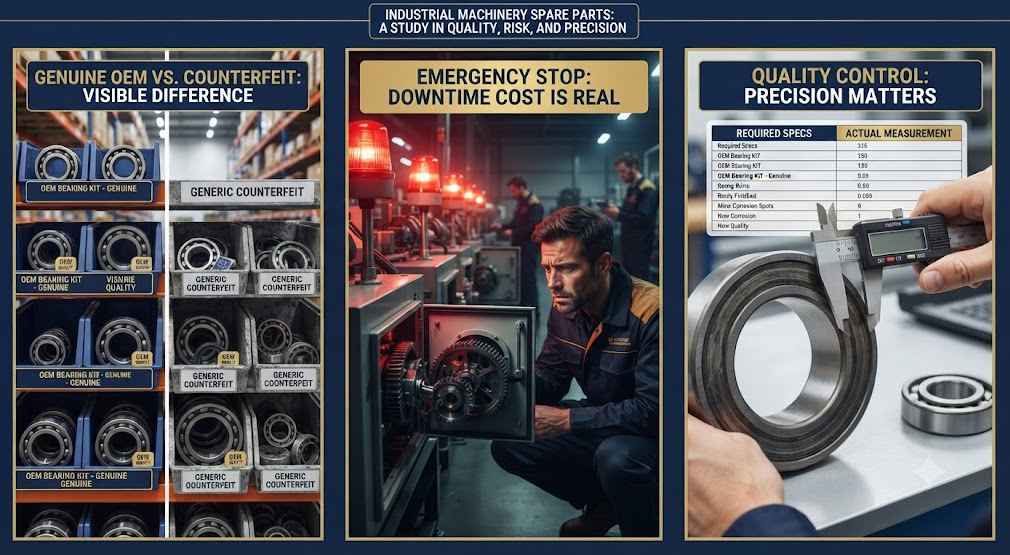
You just saved $200 buying “compatible” spare parts from a third-party supplier instead of ordering OEM parts from your original machinery manufacturer.
Three months later, your production line is down for five days. The cheap bearing failed. Your actual loss? Over $20,000 in downtime, emergency repairs, and rush shipping for the correct parts.
This is the spare parts trap I see buyers fall into repeatedly. After 15 years helping clients source machinery and manage their China supply chains, I’ve learned that the cheapest parts quote is often the most expensive choice you can make.
Here’s what actually costs you money—and how to think about spare parts procurement the smart way.
Why "Compatible" Doesn't Mean "Equivalent"
When your Chinese machinery supplier quotes $800 for a genuine spare parts kit, and a third-party vendor offers “compatible parts” for $600, the difference isn’t just $200.
What "compatible" often means:
- Similar dimensions (but tolerances might be looser)
- Same general material (but different grade or treatment)
- Looks identical (but internal composition differs)
- Works initially (but lifespan is 30-50% shorter)
The real cost equation:
- Genuine part: $800, lasts 18 months
- “Compatible” part: $600, lasts 8 months, causes 2 days downtime when it fails early
Which one actually costs less over two years?
The $24,000 Bearing That Cost $180
A food packaging equipment buyer in Mexico saved $180 buying bearings from a local supplier instead of ordering from the original Chinese manufacturer.
Planning to buy this equipment? Tell us your capacity and budget — we reply within 24 hours.
Get a factory-direct quote on WhatsAppThe timeline:
- Month 3: Bearing starts making noise
- Month 5: Bearing seizes during production
- Production stops for 5 days while they emergency-ship genuine parts from China
The actual cost:
- Lost production: $18,000 (5 days × daily output)
- Emergency shipping: $2,400 (air freight + customs rush)
- Technician callout: $3,200
- Genuine replacement parts: $180
Total: $23,780 to save $180 upfront.
The genuine bearing would have lasted 18-24 months. The “compatible” one failed at 5 months.
What Makes OEM Spare Parts Worth the Premium
Original Equipment Manufacturer (OEM) parts aren't marked up randomly. The premium covers:
- Exact specifications
Tolerances match the machine design. A bearing that’s 0.2mm off-spec might fit, but it creates vibration that damages other components over time. - Material consistency
OEM suppliers use verified material grades. Third-party parts might use similar-looking materials with different hardness, heat treatment, or corrosion resistance. - Batch traceability
When a quality issue appears, OEM suppliers can trace which production batch your part came from and proactively alert you if a recall is needed. - Warranty protection
Many machinery warranties become void if non-OEM parts cause damage. That “saving” just cost you a $50,000 warranty claim. The Parts You Should NEVER Cheap Out On
Some components have zero margin for error. Based on what I’ve seen cause the most expensive failures:
Critical wear parts:
- Bearings (especially high-speed applications)
- Seals (any fluid-contact component)
- Cutting blades or tooling (affects product quality directly)
Electrical/control components:
- PLCs and controllers
- Sensors (proximity, photoelectric, temperature)
- Servo motors and drivers
Safety components:
- Emergency stop mechanisms
- Safety guards and interlocks
- Pressure relief valves
For these, OEM parts aren’t optional. They’re insurance.
When Third-Party Parts Actually Make Sense
Not all spare parts need to be OEM. Here’s where you can save smartly:
Standard industrial components:
- Bolts, nuts, washers (if you verify grade and spec)
- Standard belts (if you match exact width, length, material)
- Basic pneumatic fittings (same thread standard)
Consumables with clear specs:
- Filters (if you match micron rating and flow rate)
- Lubricants (if you verify viscosity and additives)
- Cleaning supplies
The rule: If it’s a standard industrial part with a clear specification (not custom-made for your machine), you can source locally—BUT you must verify the specs exactly.
How to Build a Smart Spare Parts Strategy
Before Your Machine Even Ships
- Order the first spare parts kit WITH the machine
Include it in the original purchase. You get OEM parts at bulk pricing, and they ship with the machine (no separate freight cost). - Get the complete parts list with specifications
Don’t just accept part numbers. Get material specs, tolerances, and manufacturer details. This lets you source smartly later. - Identify which parts are custom vs. standard
Custom parts (made specifically for your machine): always order from OEM.
Standard parts (off-the-shelf industrial components): you have options. When You Need to Reorder - Calculate total cost, not just part price
Factor in: shipping time, freight cost, risk of downtime, warranty implications. - Keep critical parts in stock
The parts that would stop your line if they failed? Keep one spare on hand. The carrying cost is nothing compared to 3 days of lost production waiting for air freight from China. - Build a relationship with your machinery supplier
Suppliers prioritize customers who order regularly and pay on time. When you need emergency parts, that relationship gets you priority shipping and flexible payment terms. The Questions to Ask Before Buying Non-OEM Parts
Considering a third-party spare part? Ask:
- What’s the downtime cost if this part fails early?
If it’s more than 3× the price difference, buy OEM. - Will using this part void my warranty?
Check your machinery warranty terms. Many exclude coverage if non-OEM parts cause damage. - Can I verify the specifications independently?
If the third-party supplier can’t provide material certs or spec sheets, walk away. - What’s my supplier’s return policy if it doesn’t fit?
OEM parts come with application support. Third-party vendors might not accept returns on “installed” parts. - How long is the lead time for genuine parts?
If OEM parts take 6 weeks but third-party is 2 weeks, that might justify the risk—or it might mean you should keep OEM parts in stock. How We Help Clients Manage Spare Parts Procurement
At Zhenbao Trading, spare parts planning starts before the machine ships. We help clients:
- Identify which parts are truly critical (stock these)
- Separate custom components from standard industrial parts (source each smartly)
- Negotiate bulk spare parts pricing with the original manufacturer
- Verify third-party parts specifications before you order
- Manage reorder timing so you’re never paying for emergency air freight
Our approach: spend wisely, not cheaply. Keep your line running, keep your warranty valid, keep your costs predictable.
Need help building a spare parts strategy for your Chinese machinery?
Email me at sales@zhenbaotrading.com — I’ll walk you through what to stock, what to source locally, and what to always order from the OEM.
Related Equipment
Need a price, spec sheet or a pre-shipment factory inspection? Message us directly.
Get a factory-direct quote on WhatsAppWhatsApp: +852 9702 5284 · +86 158 7238 6392