If you’re buying industrial machinery from China to use in the European Union, there’s one question you must answer before you place the order:
Does this machine have the right certifications to legally enter and operate in the EU?
Get this wrong, and your machine could be held at customs, rejected by local authorities, or—worst case—banned from operation, leaving you with tens of thousands of dollars in unusable equipment.
Get it right, and your machine clears customs smoothly, meets local safety regulations, and operates legally from day one.
This guide explains exactly which certifications Chinese machinery needs for the EU market, how to verify them, and what to watch out for when your supplier says “Yes, we have CE.”
The One Certification That Matters Most: CE Marking
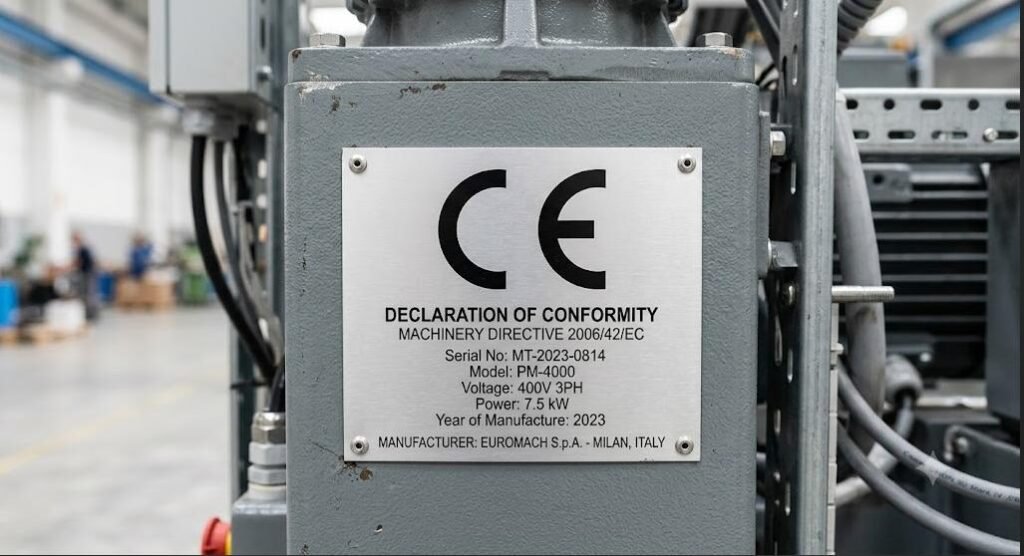
CE marking is the passport that allows machinery to be sold and used in the European Economic Area (EEA: all EU countries, plus Iceland, Liechtenstein, and Norway).
What CE marking means:
The manufacturer declares that the machine meets all relevant EU safety, health, and environmental protection standards.
It’s not a quality certification—it’s a legal requirement for most machinery sold in the EU.
Who needs CE certification?
If your machine falls into any of these categories, it needs CE marking:
- Industrial manufacturing equipment
- Packaging and processing machinery
- Food production equipment
- Construction machinery
- Lifting equipment (cranes, hoists)
- Woodworking and metalworking machines
- Textile and printing machines
Exceptions (machines that may not need CE):
- Simple hand tools with no moving parts
- Equipment used only for testing or research (not commercial production)
- Custom-built machines for your own use that are not sold or transferred
When in doubt, assume your machine needs CE marking.
What Standards Does CE Cover for Machinery?
CE marking for machinery specifically refers to compliance with the EU Machinery Directive 2006/42/EC (and its successors, including the upcoming Machinery Regulation).
Key requirements under the Machinery Directive:
- Essential Health and Safety Requirements (EHSR)
The machine must meet all applicable safety requirements, including:
- Protection against mechanical hazards (moving parts, pinch points)
- Electrical safety (proper insulation, grounding, emergency stop)
- Noise and vibration limits
- Protection against thermal and radiation hazards
- Safe design (emergency stops accessible, clear warnings)
- Technical Documentation
The manufacturer must provide:
- Declaration of Conformity (DoC) – official document stating the machine meets EU standards
- User manual in the language of the destination country
- Maintenance and safety instructions
- Wiring diagrams and technical drawings
- Harmonized Standards Compliance
The machine should be tested against relevant harmonized EN (European Norm) standards, such as:
- EN ISO 12100 – General principles for machinery safety
- EN 60204-1 – Electrical equipment of machines
- EN ISO 13849-1 – Safety-related parts of control systems
- EN 415 series – Packaging machinery safety
- Risk Assessment Documentation
The manufacturer must document:
- Identified hazards and risks
- Measures taken to eliminate or reduce each risk
- Residual risks that require user precautions
This documentation should be available for inspection by EU authorities.
How to Verify CE Certification (Because "We Have CE" Isn't Enough)
Many Chinese suppliers will tell you "Yes, we have CE certification."
But here’s the problem: CE is self-declared by the manufacturer. There’s no central EU authority that “issues” CE certificates. The manufacturer assesses their own product and declares conformity.
This means some suppliers:
- Print a CE logo on the machine without doing the actual compliance work
- Provide fake or invalid certificates
- Misunderstand which standards apply and declare conformity incorrectly
How to verify CE properly:
Step 1: Request the Declaration of Conformity (DoC)
This is the official document where the manufacturer declares CE compliance.
A valid DoC must include:
- Manufacturer’s name and address
- Machine model and serial number
- List of EU directives the machine complies with (e.g., Machinery Directive 2006/42/EC)
- List of harmonized standards applied (e.g., EN ISO 12100, EN 60204-1)
- Date and signature of authorized person
- Name and role of the person signing
Red flag: If the supplier can’t provide a DoC, or it’s missing key information, the CE claim is questionable.
Step 2: Check for a Notified Body (If Required)
Some high-risk machinery requires third-party testing by an EU Notified Body (a lab accredited to test machinery for CE compliance).
Planning to buy this equipment? Tell us your capacity and budget — we reply within 24 hours.
Get a factory-direct quote on WhatsAppExamples of machines that often require Notified Body involvement:
- Machines with high injury risk
- Lifting equipment
- Explosive atmosphere equipment
On the DoC, look for:
- Notified Body name and identification number (4-digit code)
- Test reports or certificates from the Notified Body
You can verify the Notified Body’s legitimacy on the EU’s NANDO database: https://ec.europa.eu/growth/tools-databases/nando/
Step 3: Review Technical Documentation
Ask the supplier for:
- User manual in English (or your local EU language)
- Electrical schematics and wiring diagrams
- Risk assessment documentation
- Test reports for key safety features (emergency stop, overload protection, etc.)
Professional suppliers will have this ready. If they hesitate or provide incomplete documents, it’s a warning sign.
Step 4: Hire an Independent Inspector
Before shipment, hire a third-party inspector to verify:
- CE marking is physically present on the machine (correct format and placement)
- Machine safety features work as documented (emergency stop, guards, interlocks)
- Electrical installation matches EU standards
Cost: $300-$1,000 depending on machine complexity.
Value: Confirms the machine is actually CE compliant before it ships.
What Happens If Your Machine Doesn’t Have Proper CE Certification?
At customs:
- The machine may be held for inspection
- You may be required to provide additional documentation
- In serious cases, customs can refuse entry until certification is proven
After customs:
- Local safety authorities can inspect and demand proof of CE compliance
- If non-compliant, they can ban operation until the machine is brought into compliance or removed
- You could face fines or liability if the machine causes injury and lacks proper certification
During an accident or audit:
- If a worker is injured and the machine lacks proper CE marking, your company could face legal liability
- Insurance claims may be denied if the equipment wasn’t legally compliant
Bottom line: Operating non-CE machinery in the EU is a serious legal and safety risk.
Other Certifications and Requirements to Consider
- Low Voltage Directive (LVD) – 2014/35/EU
If your machine operates on electrical voltage between 50-1000V AC or 75-1500V DC, it must also comply with LVD.
This covers:
- Electrical safety (insulation, grounding, protection against electric shock)
- Usually tested to EN 60204-1 standard
Most industrial machinery requires both Machinery Directive CE and LVD compliance.
- Electromagnetic Compatibility (EMC) Directive – 2014/30/EU
Your machine must not:
- Emit electromagnetic interference that disrupts other equipment
- Be susceptible to interference from other equipment
Tested to EN standards like:
- EN 61000 series (EMC standards)
- ATEX Directive (For Explosive Atmospheres)
If your machine will be used in an environment with explosive gases, dust, or vapors, it must comply with ATEX Directive 2014/34/EU.
Common in:
- Food processing (flour dust)
- Chemical plants
- Paint and coating facilities
- REACH and RoHS (Material Compliance)
- REACH – Restricts hazardous chemicals in products
- RoHS – Restricts certain hazardous substances in electrical equipment
Most machinery must comply with both.
Ask your supplier: "Are all materials and components REACH and RoHS compliant?"
Questions to Ask Your Supplier Before You Order
Use this checklist when discussing certifications with Chinese machinery suppliers:
| Question | Why It Matters |
|---|---|
| “Does this machine have CE marking for the EU?” | Basic legal requirement |
| “Can you provide the Declaration of Conformity (DoC)?” | Proves the CE claim is documented |
| “Which EU directives and EN standards does it comply with?” | Confirms they understand EU requirements |
| “Was a Notified Body involved in testing?” | Required for high-risk machinery |
| “Can you provide the technical file and user manual in English?” | You’ll need this for customs and local authorities |
| “Is the machine compliant with LVD and EMC directives?” | Most machines need these in addition to Machinery Directive |
| “Are all materials REACH and RoHS compliant?” | EU chemical and substance restrictions |
| “Will the CE marking be affixed to the machine before shipment?” | Must be physically present on the equipment |
If the supplier can’t answer these confidently, find another supplier.
What If the Supplier Doesn’t Have CE (But You Still Want the Machine)?
Sometimes you find the perfect machine, but the supplier doesn’t have CE certification—or their CE claim doesn’t hold up to scrutiny.
Option 1: Ask the Supplier to Obtain Proper CE
- Reputable manufacturers can work with a Notified Body or testing lab to achieve real CE compliance
- This adds time (4-12 weeks) and cost ($2,000-$10,000+ depending on machine complexity)
- Supplier may agree if you’re ordering multiple units or a large contract
Option 2: You Become the Importer of Record and Certify It Yourself
- You take legal responsibility for CE compliance
- Hire an EU-based testing lab or consultant to assess the machine and produce the DoC
- Only do this if:
- You have technical expertise or consultants who can modify the machine to meet standards
- The machine is close to compliance and just needs documentation or minor fixes
- You’re importing multiple units and the investment makes sense
Option 3: Ship to a Non-EU Country First, Modify, Then Import
- Some buyers ship to a neighboring non-EU country, make compliance modifications, then import into the EU
- Complex and expensive—rarely worth it unless the machine is truly unique
Option 4: Walk Away and Find a CE-Compliant Supplier
- Often the smartest move
- Many Chinese machinery manufacturers already serve the EU market and have proper CE in place
- Saves time, cost, and legal risk
How to Find Chinese Suppliers Who Understand EU Requirements
- Look for export experience to Europe
- Ask: “What percentage of your sales go to the EU?”
- Request references from EU customers
- Check their documentation upfront
- Serious EU-focused suppliers will provide DoC and technical files during the quotation stage
- If they hesitate or don’t understand the request, move on
- Visit their factory (or hire someone who can)
- Check if they have quality systems in place (ISO 9001 is a good sign)
- Ask to see past CE technical files for similar machines
- Work with a sourcing agent who understands EU compliance
- Agents experienced in EU markets will vet suppliers for certification before presenting them to you
- Saves you from wasting time on non-compliant suppliers
Real-World Example: What Proper CE Documentation Looks Like
Let’s say you’re importing an automatic wet wipes packaging machine to Germany.
What you should receive from the supplier:
- Declaration of Conformity (DoC) stating compliance with:
- Machinery Directive 2006/42/EC
- Low Voltage Directive 2014/35/EU
- EMC Directive 2014/30/EU
- List of harmonized standards applied:
- EN ISO 12100 (Machinery safety – general principles)
- EN 415-1 (Safety of packaging machines – general requirements)
- EN 60204-1 (Electrical equipment of industrial machines)
- EN 61000-6-2 (EMC – Immunity for industrial environments)
- EN 61000-6-4 (EMC – Emission for industrial environments)
- Technical file including:
- Risk assessment and hazard analysis
- Electrical drawings and wiring diagrams
- User and maintenance manual in German
- Test reports for safety features (emergency stop response time, overload protection)
- CE marking physically affixed to the machine in a visible, legible, and permanent manner.
If any of these are missing, incomplete, or suspicious, don’t accept the machine.
Final Checklist: Importing CE-Certified Machinery from China to the EU
- [ ] Confirm the machine type requires CE marking
- [ ] Request Declaration of Conformity (DoC) from supplier
- [ ] Verify which EU directives and EN standards are covered
- [ ] Check if a Notified Body was involved (for high-risk machines)
- [ ] Request technical documentation (user manual, risk assessment, wiring diagrams)
- [ ] Verify REACH and RoHS compliance for materials
- [ ] Confirm CE marking will be affixed to the machine before shipment
- [ ] Arrange third-party inspection before shipment to verify safety features
- [ ] Ensure all documentation is in English or your local EU language
- [ ] Keep all CE documents on file for inspection by local authorities
What If You’re Importing to the UK (Post-Brexit)?
The UK now uses UKCA marking instead of CE for most products.
Key points:
- CE marking is still temporarily accepted in the UK (exact deadline varies by product category)
- For long-term compliance, you’ll need UKCA marking
- Requirements are very similar to CE (same safety principles, similar standards)
Ask your supplier: "Can you provide both CE and UKCA marking?"
Many suppliers serving both the EU and UK markets can provide both.
Final Takeaway
CE certification is not optional, not negotiable, and not something you can fix after the machine arrives.
Before you sign the contract:
- Verify the supplier’s CE claim with documentation (DoC, technical files, standards list)
- Confirm the certifications cover all relevant EU directives (Machinery, LVD, EMC)
- Inspect the machine before shipment to verify safety features match the documentation
If a supplier can’t provide clear, complete CE documentation, find a different supplier. The legal and financial risk isn’t worth it.
Importing machinery to the EU and need help verifying certifications?
Zhenbao Trade works with EU-compliant Chinese manufacturers and can verify CE documentation on your behalf. We ensure your machine meets all EU requirements before it ships—so customs clearance and local compliance are smooth. Contact us for certified machinery sourcing.
Related Equipment
Need a price, spec sheet or a pre-shipment factory inspection? Message us directly.
Get a factory-direct quote on WhatsAppWhatsApp: +852 9702 5284 · +86 158 7238 6392