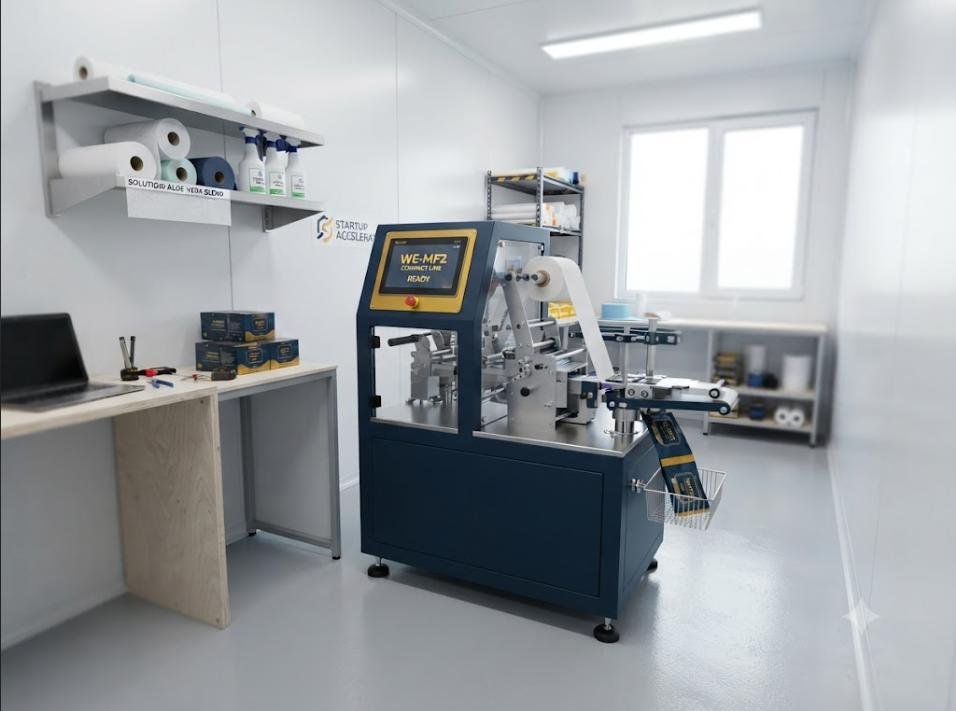
Starting a wet wipes manufacturing business doesn’t require a $200,000 factory and a full production line. With a super mini wet wipes machine, you can launch production for under $50,000—and scale up as your business grows.
After 15 years helping startups enter the wet wipes market across Southeast Asia, the Middle East, and Latin America, I’ve seen the super mini approach succeed over and over. Here’s why it’s the smart choice for new manufacturers.
What Is a Super Mini Wet Wipes Machine?
A super mini wet wipes machine is a compact, all-in-one production line designed for small-scale manufacturing. Unlike industrial high-speed lines that require large facilities and teams, super mini machines are:
Compact: Typically 3-5 meters long, fitting in 40-60 square meters
Affordable: $35,000-$50,000 vs $100,000+ for mid-range lines
Efficient: Produce 80-120 packs per minute (1.2-1.7 million packs/month)
Simple to operate: 1-2 operators needed, vs 4-6 for larger lines
Quick to install: 5-7 days commissioning vs 2-3 weeks for complex lines
Why Startups Choose Super Mini Machines
- Low Initial Investment
The biggest barrier to entering manufacturing is upfront capital. A super mini machine removes that barrier.
Total startup cost comparison:
Super Mini Setup (~$60,000-$80,000):
- Machine: $40,000-$50,000
- Installation & training: $3,000-$5,000
- Initial raw materials: $5,000
- Factory setup (basic): $8,000-$15,000
- Working capital: $5,000
Mid-Range Setup (~$150,000-$200,000):
- Machine: $100,000-$150,000
- Installation & training: $8,000-$12,000
- Raw materials: $15,000
- Factory setup (larger space, utilities): $20,000-$30,000
- Working capital: $10,000
For a startup with limited funding, the $80K path is achievable. The $200K path often requires loans you’re not ready to take on.
- Faster Break-Even Point
Lower investment means you need fewer sales to become profitable.
Example: Super Mini ROI Calculation
Assumptions:
- Machine cost: $45,000
- Production: 50,000 packs/day (one 8-hour shift)
- Selling price: $0.15/pack (wholesale)
- Production cost: $0.08/pack (materials, labor, overhead)
- Profit per pack: $0.07
Monthly profit: 50,000 packs/day × 25 days × $0.07 = $87,500
Break-even: $45,000 ÷ $87,500 = ~6 months
Compare that to a $120,000 mid-range machine requiring 16+ months to break even at similar margins.
- Perfect for Testing Markets
If you’re launching a new brand or entering a new region, you don’t yet know which products will sell best.
A super mini machine gives you flexibility to:
✓ Test multiple product formats (baby wipes, makeup remover, sanitizing wipes, antibacterial wipes)
✓ Experiment with packaging sizes (10-pack, 20-pack, travel sizes)
✓ Adjust formulations based on customer feedback
✓ Pivot quickly if one product underperforms
One of our clients in the Philippines started with antibacterial wipes for hospitals. After 6 months, they discovered baby wipes for retail had higher margins and less competition. They shifted focus—something they couldn’t have done if they’d invested $150K in a specialized high-speed line.
- Minimal Space Requirements
Factory space is expensive—especially in cities.
Super mini footprint: 40-60 sqm total (machine + raw material storage + packing area)
This fits in:
- Small industrial unit
- Warehouse section
- Converted garage/workshop space
You don’t need to lease a 500 sqm facility and pay for space you’re not using. Start small, prove the business, then expand.
- Lower Operational Costs
Labor: 1-2 operators per shift vs 4-6 for larger lines
Utilities: Lower power consumption (typically 10-15 kW vs 30-50 kW)
Maintenance: Simpler machines = fewer parts to maintain, lower costs
These savings add up month after month.
- Easier to Learn and Operate
Super mini machines are designed for operators without specialized technical backgrounds.
Planning to buy this equipment? Tell us your capacity and budget — we reply within 24 hours.
Get a factory-direct quote on WhatsAppTraining takes 3-5 days vs 2-3 weeks for complex multi-station lines.
This matters when:
- You’re training your first production team
- You need to replace an operator quickly
- You’re running a family business without access to skilled technicians Real Success Stories: Startups That Started with Super Mini Machines
Case 1: Baby Wipes Startup in Mexico
Started with a $42,000 super mini machine, producing baby wipes for local pharmacies.
- Month 1-3: Testing formulations and building relationships with 5 pharmacy chains
- Month 4-8: Secured shelf space in 30 stores; scaled to 40,000 packs/day
- Month 12: Added a second super mini machine to double capacity
- Month 18: Upgraded to a mid-range line; kept the super mini for specialty products
Total investment over 18 months: $130,000. Revenue in month 18: $180,000/month.
Case 2: Sanitizing Wipes in Saudi Arabia
Entrepreneur with a background in retail saw opportunity during increased hygiene awareness.
- Started with a super mini machine in a 50 sqm rented unit
- Focused on bulk sales to offices and schools
- Break-even in 7 months
- Profitable by month 9; expanded to hand sanitizer wipes and surface wipes
Key advantage: Low overhead let them compete on price while maintaining healthy margins.
Case 3: Makeup Remover Wipes in Indonesia
Beauty salon owner wanted to create a private-label product line.
- Super mini machine allowed production of small batches (500-1,000 units)
- Tested 4 different formulations with customers
- Once the winning formula was clear, scaled production
- Now supplies 50+ salons and retail stores
She couldn’t have done this with a high-speed line requiring minimum batch sizes of 50,000 units.
When a Super Mini Machine Is the Right Choice
✅ You’re a startup with limited capital (under $100K total investment budget)
✅ You’re testing a new market or product and want flexibility
✅ Your initial target is under 1 million packs/month
✅ You have limited factory space (under 100 sqm available)
✅ You want to minimize operational complexity and keep labor lean
✅ You’re building a niche or private-label brand (not competing on massive volume)
When You Might Need a Larger Machine Instead
If your situation looks like this, consider starting with a mid-range line:
❌ You already have signed contracts for 2+ million packs/month
❌ You’re supplying large retailers with strict volume requirements
❌ You have access to $150K+ in startup capital
❌ Your market is mature and you need to compete on per-unit cost from day one
Key Features to Look for in a Super Mini Machine
Not all super mini machines are created equal. Here's what matters:
- Control System
- Look for Mitsubishi or Siemens PLC
- Avoid generic “custom” control systems (harder to get parts and support)
- Build Quality
- Stainless steel frame (304 grade minimum for durability and hygiene)
- Avoid machines with too much plastic or lightweight construction
- Speed Adjustment
- Machine should allow you to run at 60-100% speed
- Flexibility is critical when testing products or training new operators
- Ease of Changeover
- How long does it take to switch from 10-pack to 20-pack format?
- Look for tool-free adjustments where possible
- Spare Parts Availability
- Are critical components (sensors, motors, blades) standard and available locally?
- Can you buy a spare parts kit at purchase time?
- After-Sales Support
- Does the supplier provide remote troubleshooting (WhatsApp, video call)?
- What’s the response time for technical questions?
- Is installation and operator training included? The Super Mini to Mid-Range Upgrade Path
Here's the typical growth timeline I see with successful startups:
Months 1-6: Ramp up production, test products, build customer base
Months 7-12: Hit consistent capacity (running at 70-80%), secure repeat orders
Months 13-18: Decision point:
- Add a second super mini machine (doubles capacity, low risk)
- OR upgrade to a mid-range line (better per-unit economics, higher upfront cost)
Many successful manufacturers keep their original super mini machine even after upgrading—they use it for:
- Specialty/niche products
- Small custom orders
- R&D and product testing
- Backup capacity during peak seasons Cost Breakdown: What to Budget
Here's a realistic breakdown for starting with a super mini machine:
| Item | Cost (USD) |
|---|---|
| Super mini wet wipes machine | $40,000-$50,000 |
| Shipping & import duties | $5,000-$8,000 |
| Installation & commissioning | $3,000-$5,000 |
| Operator training | Included or $1,000-$2,000 |
| Factory setup (space, utilities, furniture) | $8,000-$15,000 |
| Initial raw materials (1 month) | $5,000-$8,000 |
| Spare parts kit | $2,000-$3,000 |
| Working capital buffer | $5,000-$10,000 |
| Total Startup Investment | $69,000-$101,000 |
Ongoing Monthly Costs
Once you're operating, expect:
| Item | Monthly Cost (USD) |
|---|---|
| Raw materials (50K packs/day) | $10,000-$15,000 |
| Labor (2 operators, 1 supervisor) | $2,000-$4,000 (varies by country) |
| Factory rent & utilities | $1,000-$3,000 |
| Maintenance & consumables | $500-$1,000 |
| Total Monthly Operating Cost | $13,500-$23,000 |
At a selling price of $0.15/pack and 50,000 packs/day, monthly revenue = $187,500. Healthy margins even in month one.
Common Questions from Startups
Q: Can I really make a profit with such a small machine?
Yes—if you focus on the right markets. Super mini machines work best for:
- Local/regional brands (not competing with massive national brands)
- Niche products (makeup remover, pet wipes, specialty formats)
- B2B sales (offices, salons, clinics, schools)
- Private label production for retailers
Q: How long until I need to upgrade?
Most startups run a super mini for 12-24 months before considering expansion. Some keep it indefinitely if they’re happy with current volume and margins.
Q: Can I export products made on a super mini machine?
Absolutely. Product quality depends on your raw materials and process control—not machine size. Many of our clients export regionally.
Q: What if I outgrow it quickly?
That's a good problem! You can:
- Add a second super mini (fast, low-risk)
- Upgrade to mid-range and keep the super mini for specialty products
- Sell the super mini (used market exists) and buy a larger line How to Choose the Right Super Mini Supplier
Key questions to ask:
- “Can I see a video of this exact machine running at your factory?” (Not a showroom clip—a real production test)
- “What brand PLC and motors do you use?” (Mitsubishi/Siemens PLC = good; “our system” = risky)
- “What’s included in the price?” (Installation? Training? Spare parts? Shipping?)
- “Can you provide 2-3 references from buyers in my region?” (Call them!)
- “What’s your after-sales support process?” (How do I reach you? Response time? Remote help?)
- “Do you have machines running in [my country]?” (Easier for support and parts) The Bottom Line
A super mini wet wipes machine is the fastest, lowest-risk way to enter the wet wipes manufacturing business.
With $60K-$80K total investment, you can:
- Launch production in 30-45 days
- Test products and markets with minimal risk
- Break even in 6-12 months
- Scale up when (not if) demand grows
If you’re exploring wet wipes production as a startup or small business in Southeast Asia, the Middle East, or Latin America, we help buyers choose the right equipment, verify suppliers, and plan the setup from factory space to first production run.
Related Equipment
Need a price, spec sheet or a pre-shipment factory inspection? Message us directly.
Get a factory-direct quote on WhatsAppWhatsApp: +852 9702 5284 · +86 158 7238 6392