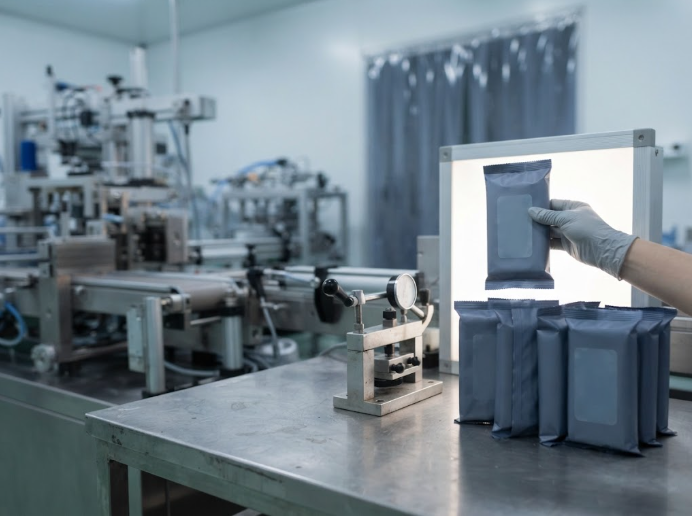
A pack that leaks is usually discovered the same way. Someone in the warehouse squeezes a pack, sees a bead of solution at the seam, and the line stops while the sealing jaws are blamed.
Heat gets turned up. The jaws get replaced. The line runs again, and a week later the same complaint comes back from a different customer.
The sealing jaw is where the symptom appears, not where the cause lives. In most wet wipes lines, the seal is the last place the fault shows up and the first place somebody adjusts — which is precisely why the same problem keeps returning.
Here are the five points in the sealing station that actually decide whether a pack holds, and what to check at each one.
- Temperature set by the dial, not by the film
Most machines let you dial in a sealing temperature, and most operators find a number that works, write it on the machine, and leave it there.
The problem is that the temperature the film needs is a property of the film, not of the machine. Change the film gauge, change the coating, change to a different laminate structure, and the number on the dial becomes a guess.
Worse, the temperature that produces the fastest seal is not the temperature that produces the strongest one. Push the jaw temperature too high and the inner sealing layer thins out under pressure. The seal looks perfect coming off the line and fails after the pack has been sitting in a carton for a few weeks — which is the worst possible failure mode, because it reaches the customer before it reaches your QC bench.
What to do instead: when a new film roll is loaded, run a short seal-strength check rather than trusting the dial. Keep the check results with the roll number. When a complaint arrives months later, you can trace it to the material that caused it.
- Dwell time, which changes every time the line speed does
Sealing is a function of temperature, pressure and time. Operators adjust speed to hit an output target, and every change in speed changes how long the film sits between the jaws.
This is the quietest of the five failure points. Nothing is broken, nothing is out of specification, and the machine is doing exactly what it was told. But raise the line speed for a big order and the dwell time shortens — and the seal that was comfortable at the lower speed becomes marginal.
The practical fix is not to hold the line at one speed forever. It is to define a sealing window: a range of speeds at which the seal has been verified, and a rule that any run outside that window gets a seal check before it is packed.
- Jaw pressure, and whether the two faces are actually parallel
Two jaws that meet unevenly will produce seals of uneven quality along the same pack — strong at one end of the seam, weak at the other. That pattern is easy to miss if you only pull one pack per shift.
Pressure comes from two places: the pneumatic or mechanical setting, and the mechanical alignment of the jaw faces themselves. The second one drifts. Bearings wear, mounting bolts loosen, and a jaw that was parallel at commissioning is no longer parallel a year later.
The check is mechanical, not electronic. With the machine isolated, close the jaws on a strip of pressure-sensitive indicator paper or film and read the imprint. It takes minutes and it catches a fault that no amount of temperature adjustment will fix.
- Contamination in the seal area
This is the failure point that is unique to wet wipes, and it is the one most often overlooked when a line is borrowed from a dry-packaging application.
Wet wipes carry solution. If the solution reaches the sealing zone — through splash, through wicking along the film edge, through a fold that is wet when it should be dry — no seal forms where the liquid sits. The pack will often hold at the moment of testing and weep later.
Planning to buy this equipment? Tell us your capacity and budget — we reply within 24 hours.
Get a factory-direct quote on WhatsAppSources worth checking:
- Solution carryover from the wetting section, getting further along the film path than intended
- Condensation inside the machine, which is a housekeeping issue as much as a design one
- Residual solution on the forming collar or the film path, which transfers to the seal zone
- A folding section that leaves the seal area damp at the edges
The seal area has to be dry before the jaws close. If it is not, you are sealing through a thin film of liquid, and the machine is not at fault.
- Film tension and the roll you just changed
Film is not dimensionally constant. Gauge varies slightly across the web and from roll to roll, and a splice introduces a step change that travels down the line.
If tension is set for the average roll, a slightly thin roll will stretch more as it runs, and the seal zone gets less material under the jaws than the setting assumed. The symptom appears as intermittent leakage concentrated at a particular point in the roll — which is exactly the pattern that tells you the fault is in the material, not in the machine.
Track roll changes on the same sheet as your seal checks. Intermittent faults that correlate with roll changes are material problems. Intermittent faults that do not are mechanical ones.
A note on where the line came from
Wet wipes converting is not dry packaging with a wet section bolted on. The presence of solution changes the sealing problem fundamentally, and machines specified for dry products frequently underperform when they are moved into this application — not because they are badly built, but because the specification was wrong for the job.
When you are buying, ask the supplier how the sealing station is protected from solution carryover and what the specified sealing window is. A supplier who has built wet wipes lines will answer immediately. See our wet wipes machinery range for the configurations we supply.
What to do on Monday morning
- Run a seal-strength check on the current roll and record it against the roll number
- Close the jaws on indicator film and read the imprint — parallelism first, pressure setting second
- Define a verified speed window and require a seal check for any run outside it
- Walk the film path from the wetting section forward and find where it is wet when it should be dry
- Put seal check results and roll changes on the same sheet, and read the correlation after two weeks
None of these five steps requires a spare part. Three of them cost nothing at all. What they cost is a habit — and the alternative is replacing jaws that were never the problem.
Frequently asked questions
Why do my wet wipes packs leak even though the seal temperature is correct?
Temperature is only one of three variables. Check dwell time against line speed, jaw pressure and parallelism, and whether the seal area is dry when the jaws close.
How do I check if my sealing jaws are parallel?
With the machine isolated and locked out, close the jaws on pressure-sensitive indicator film and inspect the imprint. An uneven imprint means the jaw faces need mechanical realignment.
Can I run different film types on the same sealing settings?
Not reliably. The sealing window is a property of the film structure. Verify a short seal check whenever the film specification, gauge or supplier changes.
My machine was bought for dry packaging and now runs wet wipes. Can it be adapted?
Sometimes, but the sealing station and the solution containment around it usually need attention. Have the supplier assess the sealing zone protection and the specified sealing window before you commit to the conversion.
How often should I run seal tests?
At every roll change and at the start of every production run outside your verified speed window — and on any complaint, traced back to the roll number.
Buying a line, or fixing one
Zhenbao Trading supplies wet wipes and hygiene converting machinery from China, and works as a sourcing partner for buyers who need the specification checked before the deposit goes out. Our standard terms are 30% deposit with the balance before shipment, around 60 days production lead time for a standard model, and a 12-month warranty on the whole machine with wear parts excluded.
If you are specifying a new line and want the sealing section reviewed against your film and your product, send us the detail. If you already have a line with a problem, our sourcing service also covers factory-level troubleshooting and spare parts sourcing.
Get a quote in 24 hours. WhatsApp +852 9702 5284, or email sales@zhenbaotrading.com.
Maggie (岳乙晴)
Founder / Sales Director
Zhenbao Trading | Machinery Sales & China Sourcing Agent
sales@zhenbaotrading.com
WhatsApp: +852 9702 5284
www.zhenbaotrading.com
Five years in cross-border trade, supplying hygiene and packaging machinery from China.
Related Equipment
Need a price, spec sheet or a pre-shipment factory inspection? Message us directly.
Get a factory-direct quote on WhatsAppWhatsApp: +852 9702 5284 · +86 158 7238 6392