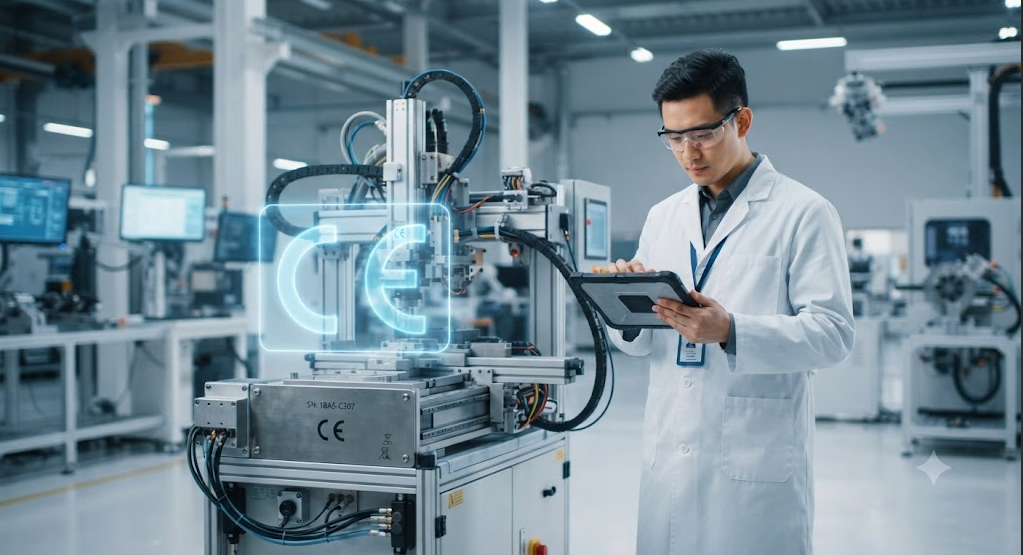
If you’re importing industrial machinery from China into the EU, one abbreviation will follow you through every conversation, quotation, and customs form: CE.
But here’s the uncomfortable truth most first-time buyers discover too late: CE marking isn’t something your Chinese supplier can simply “give you.” It’s a declaration you make as the importer — and you’re legally responsible if it’s wrong.
This guide explains what CE marking actually is, who’s responsible for it, how Chinese suppliers fit into the picture, and the practical steps to get it right before your machine lands in Hamburg, Rotterdam, or Piraeus.
What CE Marking Actually Means
CE stands for Conformité Européenne — “European Conformity.” It’s a mark that indicates a product meets EU safety, health, and environmental protection standards.
It is not:
- A quality certificate
- Proof that the product was tested by a third party
- A guarantee the machine is safe
It is:
- A manufacturer’s (or importer’s) declaration that the product complies with applicable EU directives
- A legal requirement for selling or putting machinery into service in the EEA (European Economic Area)
- Your responsibility if you’re the first entity placing it on the EU market
Who Is Responsible for CE Marking?
Under the EU Machinery Directive (2006/42/EC), responsibility falls to:
- The manufacturer — if they’re established in the EU
- The importer — if the manufacturer is outside the EU (e.g., China) and you’re the first entity bringing it into the EEA
- An authorized representative — if the Chinese manufacturer appoints one in the EU
In the vast majority of cases where you buy directly from a Chinese factory, you are the legal manufacturer for CE purposes. That means:
- You must ensure the machine meets the relevant directives
- You must prepare (or have prepared) the technical file
- You sign the Declaration of Conformity
- You affix the CE mark
Yes, your Chinese supplier can and should help — but the legal liability sits with you.
What EU Directives Apply to Machinery?
Your machine will likely need to comply with:
| Directive | Applies to |
|---|---|
| Machinery Directive 2006/42/EC | Almost all machinery |
| Low Voltage Directive (LVD) 2014/35/EU | Electrical equipment 50–1000V AC |
| Electromagnetic Compatibility (EMC) 2014/30/EU | Anything with electronic components |
| ATEX 2014/34/EU | Equipment used in explosive atmospheres |
| Pressure Equipment Directive (PED) 2014/68/EU | Pressure vessels, boilers, etc. |
For a typical wet wipes packaging machine or CNC lathe, you’ll be dealing with:
- Machinery Directive (mandatory)
- LVD (if powered)
- EMC (almost always)
The Process: How to Get CE Marking for a Chinese Machine
Step 1: Know Which Standards Apply
Each directive references harmonized standards — technical documents that describe how to meet the requirements.
For machinery, the core standard is EN ISO 12100 (safety of machinery — general principles for design). Depending on the machine type, you may also need:
- EN 60204-1 (electrical equipment of machines)
- EN ISO 13849-1 (safety-related parts of control systems)
- EN 61000 series (EMC)
Your supplier should know these. If they say “we can do CE,” ask: “Which standards does your machine comply with?”
If they can’t name them, that’s a red flag.
Step 2: Risk Assessment
You (or your supplier, or a consultant) must perform a risk assessment per EN ISO 12100. This identifies hazards (moving parts, electrical shock, noise, etc.) and documents the protective measures.
This isn’t optional paperwork — it’s the foundation of the technical file.
Step 3: Prepare the Technical File
The technical file must include:
- General description of the machinery
- Design drawings, wiring diagrams, pneumatic/hydraulic schematics
- Risk assessment
- List of applied standards
- Copies of relevant test reports (EMC, LVD, etc.)
- User manual and maintenance instructions in the language of the destination country
- Copy of the Declaration of Conformity
Your Chinese supplier should provide most of this. But you (or your consultant) must verify it’s complete, accurate, and in the correct language.
Step 4: Testing (If Required)
Some directives require testing by a notified body (an EU-accredited lab). For most standard machinery, self-certification is allowed — meaning no third-party test is mandatory.
Planning to buy this equipment? Tell us your capacity and budget — we reply within 24 hours.
Get a factory-direct quote on WhatsAppHowever, you or your supplier should still conduct:
- EMC testing (to prove it doesn’t interfere with other equipment and vice versa)
- Electrical safety testing per EN 60204-1
Many reputable Chinese manufacturers have reports from EU or TÜV-accredited labs. If your supplier doesn’t, you can arrange testing in China (cheaper) or after import (more expensive, but gives you control).
Step 5: Declaration of Conformity
Once you’re confident the machine complies, you issue a Declaration of Conformity (DoC). This is a signed document stating:
- The machine model and serial number
- Your company name and address (as the “manufacturer”)
- The directives and standards it complies with
- Your signature and date
The DoC must accompany the machine and be available to authorities on request.
Step 6: Affix the CE Mark
The CE mark must be:
- Visible, legible, and indelible
- At least 5 mm high (unless the product is smaller)
- Affixed to the machine or its data plate
Your Chinese supplier may physically apply it, but only after you’ve confirmed compliance and prepared the DoC.
Common Pitfalls When Buying from China
- “We have CE” ≠ “We meet CE requirements”
Many Chinese suppliers will say “we have CE” and show you a certificate. Often, this is:
- A test report (not a Declaration of Conformity)
- A certificate from a non-accredited body
- A template DoC with no technical file behind it
What to ask:
- “Can I see the technical file?”
- “Which notified body reviewed this?” (If they claim one did)
- “Can you provide the risk assessment and test reports?”
- Using a “CE Certificate” as a Shortcut
There is no such thing as a “CE certificate” issued by the EU. CE is a self-declaration. If someone offers to sell you one, walk away.
- Assuming the Supplier Is Responsible
Even if your contract says “supplier will provide CE,” you are the legal manufacturer if you import it. Customs, regulators, and courts will come to you, not the factory in Dongguan.
- Not Translating the Manual
The instruction manual must be in the official language(s) of the country of use. A Chinese supplier may provide an English manual, but if you’re importing to Germany, you need a German version. Budget for professional translation.
What Happens If You Get It Wrong?
Penalties vary by country, but can include:
- Customs refusal or seizure
- Fines (€5,000–€100,000+ depending on severity)
- Forced machine withdrawal from service
- Liability for accidents or injuries
- Criminal prosecution in extreme cases
Even if you never get caught, your insurance may refuse to cover an accident if the machine wasn’t properly CE-marked.
How to Protect Yourself
- Work with a CE consultant if this is your first import. Cost: €1,500–€5,000 depending on machine complexity. Worth it.
- Include CE compliance as a contract clause, specifying which standards and who provides what documentation.
- Arrange third-party testing (even if not required) for peace of mind and evidential weight.
- Inspect the technical file before final payment. Don’t accept “we’ll send it later.”
- Visit the factory or send an inspector to verify safety features in person.
Can Chinese Suppliers Handle CE Themselves?
Some can. The best Chinese machinery manufacturers:
- Design to EU standards from the start
- Maintain relationships with TÜV or other EU test labs
- Provide complete, accurate technical files in English
- Employ EU-based engineers or consultants
These suppliers exist, but they’re the minority. Expect to pay 10–20% more than a factory that simply slaps a CE sticker on the machine and hopes for the best.
Final Checklist Before You Sign
Before you commit to a supplier, verify:
- [ ] They can name the specific EU directives and harmonized standards
- [ ] They will provide a complete technical file in English (or your language)
- [ ] They’ve done EMC and electrical safety testing (ask for reports)
- [ ] The user manual will be professionally translated
- [ ] You’ll receive the Declaration of Conformity template to review before shipment
- [ ] They understand you are the legal manufacturer and will cooperate with any authority requests
Conclusion
CE marking isn’t a rubber stamp — it’s a process. When done right, it protects you legally, ensures your machine is safe, and prevents costly delays at customs.
When buying Chinese machinery, don’t ask “Do you have CE?” Ask: “Can you show me the technical file, test reports, and risk assessment?”
That’s the difference between a compliant machine and a expensive paperweight stuck in a warehouse while you scramble to fix documentation you should have verified before the boat sailed.
Need help sourcing CE-compliant machinery from China? Contact us — we manage compliance, testing, and documentation so you don’t end up learning EU law the hard way.
Related Equipment
Need a price, spec sheet or a pre-shipment factory inspection? Message us directly.
Get a factory-direct quote on WhatsAppWhatsApp: +852 9702 5284 · +86 158 7238 6392