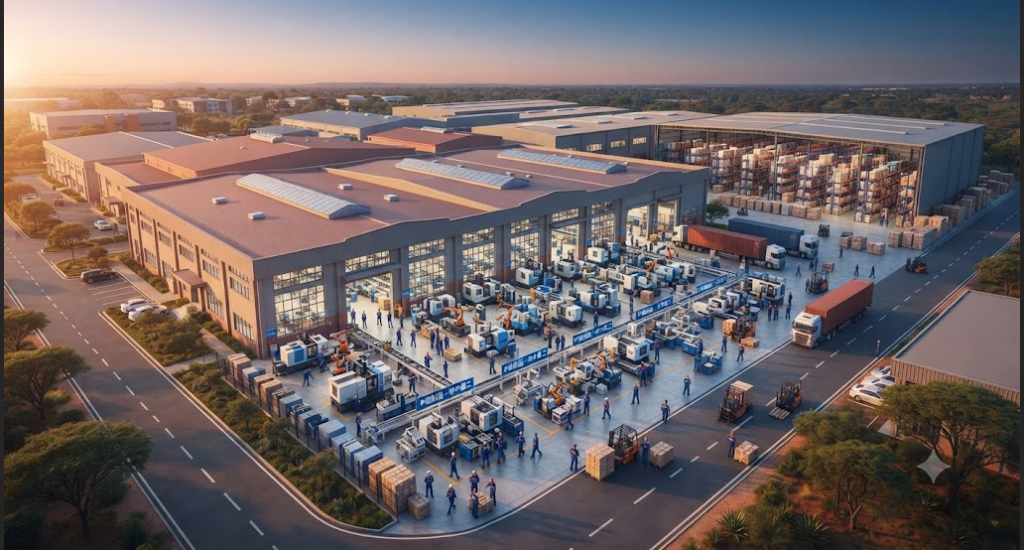
For decades, Africa imported finished goods from China — everything from textiles to hygiene products to packaged foods. But over the past five years, a quiet shift has been underway: African manufacturers are now importing Chinese machinery to produce those goods locally.
This isn’t just about cost savings. It’s a strategic move toward industrial self-sufficiency, job creation, and reduced dependence on imported consumer goods. And Chinese equipment suppliers — flexible, affordable, and willing to work with smaller buyers — have become the engine driving this transformation.
This article explores which African industries are leading the charge, what types of machinery they’re buying, and what this trend means for both African entrepreneurs and global suppliers.
Why African Manufacturers Are Choosing Chinese Machinery
- Price-to-Performance Ratio
European and American machinery often comes with price tags that are out of reach for small and mid-sized African manufacturers. Chinese equipment offers:
- 60–70% lower capital cost for comparable output
- Financing options and flexible payment terms
- Willingness to work with first-time buyers and smaller order volumes
For a Nigerian wet wipes startup or a Kenyan food packaging company, the difference between a €150,000 Italian line and a $45,000 Chinese alternative is often the difference between “not feasible” and “let’s do it.”
- Growing Local Demand
Africa’s middle class is expanding. Disposable income is rising. And consumers increasingly expect locally-made products that meet international quality standards.
Key growth sectors include:
- Hygiene products (sanitary pads, wet wipes, diapers)
- Food packaging (snacks, coffee, grains, dairy)
- Beverages (bottled water, juice, energy drinks)
- Pharmaceuticals (tablets, capsules, syrups)
- Construction materials (tiles, PVC pipes, aluminum profiles)
Importing finished goods means thin margins, currency risk, and long lead times. Producing locally means faster go-to-market, better margins, and the ability to tailor products to local preferences.
- Government Incentives and Trade Policy
Many African governments are actively promoting local manufacturing through:
- Import substitution policies (higher tariffs on finished goods, lower tariffs on machinery)
- Tax holidays for new manufacturing facilities
- SEZ (Special Economic Zone) benefits — duty-free imports of production equipment
- Local content requirements in public procurement
Countries like Ethiopia, Kenya, Nigeria, Ghana, and Rwanda have all introduced policies that make investing in production equipment more attractive than continuing to import finished products.
Which Industries Are Leading the Shift?
- Hygiene Products (Sanitary Pads, Wet Wipes, Diapers)
This is one of the fastest-growing sectors for Chinese machinery imports into Africa.
Why?
- High local demand (population growth, urbanization, rising hygiene standards)
- Products are consumable and repeat-purchase
- Modest startup capital (a semi-auto sanitary pad line can start under $30,000)
- Strong profit margins (200–400% markup on raw materials)
What they're buying:
- Sanitary napkin machines (semi-auto and fully automatic)
- Wet wipes production lines (single-lane sachet and canister systems)
- Adult diaper and baby diaper machines
Where it's happening:
- Nigeria leads in volume
- Kenya and Uganda have strong regional distribution networks
- Ghana is seeing growth in private-label feminine hygiene brands
- Food Packaging and Processing
African food brands are moving from manual or semi-manual packaging to automated vertical form-fill-seal (VFFS) lines, stand-up pouch fillers, and vacuum packaging systems.
What they're buying:
- VFFS machines for coffee, flour, spices, snacks
- Liquid filling lines for cooking oil, honey, fruit juice
- Vacuum packaging for meat and fish
- Carton sealing and end-of-line automation
Why Chinese equipment wins here:
- Smaller manufacturers (100–500 kg/hour output) can’t justify European capex
- Chinese suppliers offer pilot lines — affordable entry systems that can scale later
- Support for African food types (e.g., cassava flour, palm oil) that European machines aren’t optimized for
Where it's happening:
- Kenya (coffee, tea, flour)
- Ghana (cocoa products, packaged rice)
- South Africa (meat, dairy, wine — though they also buy European)
- Beverage Production (Bottled Water, Juice, Soft Drinks)
Bottled water and juice production is booming across Africa. Entrepreneurs are setting up regional bottling plants to serve urban and rural markets without the logistics burden of national distribution.
What they're buying:
- Complete water bottling lines (washing, filling, capping, labeling)
- Juice filling and hot-fill systems
- Blow molding machines (to produce their own PET bottles in-house)
Chinese suppliers dominate this segment because they offer turnkey lines — a full production system from one vendor, pre-tested and ready to install.
Planning to buy this equipment? Tell us your capacity and budget — we reply within 24 hours.
Get a factory-direct quote on WhatsAppWhere it's happening:
- Nigeria, Ghana, Tanzania, Ethiopia
- Often funded by diaspora entrepreneurs or regional FMCG brands
- Pharmaceuticals and Nutraceuticals
Local pharmaceutical production is a priority across Africa, driven by:
- Supply chain disruptions (COVID-19 exposed reliance on imports)
- Regulatory push for local manufacturing (e.g., Nigeria’s NAFDAC)
- Lower cost of locally-made generics
What they're buying:
- Tablet presses and capsule filling machines
- Blister packaging lines
- Syrup and liquid medicine filling systems
Where it's happening:
- Nigeria has the most established pharma sector
- Kenya is a regional hub
- South Africa leads in quality and scale but also imports finishing/packaging lines from China
- Plastics and Packaging Materials
Rather than importing plastic containers, bottles, and packaging film, African manufacturers are increasingly making their own.
What they're buying:
- Injection molding machines (for caps, jars, containers)
- Blow molding machines (for bottles)
- Extrusion lines (for plastic film and bags)
This is a high-volume, commodity play — the economics only work if you’re supplying multiple brands. But once profitable, it’s very sticky (customers depend on you).
Where it's happening:
- Nigeria, Kenya, Egypt, South Africa
What African Buyers Look For (And What Frustrates Them)
What Works
- Supplier willingness to work with smaller MOQs — African buyers often can’t commit to huge orders upfront
- Flexible payment terms (30/70 or even 20/40/40 split payments)
- On-site installation and training included in the contract
- Spare parts packages — buyers want critical spares shipped with the machine to avoid months-long delays later
- Turnkey solutions — fewer vendors to coordinate What Frustrates Them
- Language barriers and slow communication
- Machines arriving without proper documentation (especially CE marking, which is required for formal import into some African markets)
- No after-sales support — when something breaks, the supplier is unreachable
- Overpromising on output — “150 packs per minute” in the quote becomes 90 ppm in reality
- Hidden costs — surprise charges for electrical work, installation supervision, or “technical guidance”
Advice for African buyers: Work with a sourcing agent or trusted intermediary who can hold the supplier accountable and manage the technical handover.
Case Study: Nigerian Wet Wipes Manufacturer
Background:
A Lagos-based entrepreneur wanted to launch a private-label wet wipes brand for the Nigerian market. Importing finished wipes from China meant low margins and no control over formulation or packaging.
Solution:
Purchased a semi-automatic wet wipes machine from a Chinese supplier for $28,000 (FOB Ningbo). Output: 30–40 packs per minute.
What went well:
- Machine was tested via video call before shipment
- Supplier included 6 months of spare parts
- Training was conducted on-site (2 technicians, 5 days)
Challenges:
- Power supply in the factory was unstable; had to install a voltage stabilizer ($800)
- Initial yield was 70% due to operator inexperience; improved to 92% after 3 weeks
Outcome:
Now producing 50,000 packs/day, selling to regional distributors. Payback period: 14 months.
What This Means for Chinese Suppliers
African markets represent a massive, underserved opportunity — but they require a different approach than selling to Europe or North America.
Keys to success:
- Offer starter/pilot lines — lower-capacity machines that let buyers test the market before scaling
- Build in after-sales support — phone/video troubleshooting, fast spare parts shipping, local agent networks
- Simplify installation — machines that don’t require highly skilled technicians or exotic tools
- Be patient on payment terms — African buyers often need 60–90 days to ramp up production and cash flow
The suppliers who get this right will build long-term relationships — and as those African manufacturers grow, they’ll come back for expansion lines, auxiliary equipment, and referrals.
What This Means for African Entrepreneurs
If you're considering local manufacturing:
- Start small. Don’t over-invest in capacity you can’t fill. A semi-auto line is often enough to test the market.
- Factor in hidden costs. Budget 20–30% above the machine price for shipping, installation, voltage stabilizers, initial raw material stock, and working capital.
- Secure distribution before you buy the machine. The machine is the easy part; selling 10,000 units/month is the hard part.
- Get training. Insist on on-site operator training and document everything (videos, manuals, checklists).
- Plan for spare parts. Order critical spares with the machine. Waiting 8 weeks for a $50 part to ship from China can cost you $10,000 in lost production.
Conclusion
African manufacturers are no longer just importing goods from China — they’re importing the tools to make those goods themselves.
This shift is being driven by rising local demand, supportive government policy, and the affordability and flexibility of Chinese machinery. And it’s happening across hygiene products, food packaging, beverages, pharma, and plastics.
For African entrepreneurs, this is a once-in-a-generation opportunity to build profitable, scalable manufacturing businesses.
For Chinese suppliers, this is a market that rewards patience, flexibility, and genuine partnership — not just transaction-based selling.
The next wave of African industrialization is being built one Chinese machine at a time.
Need help sourcing machinery for the African market? Contact us — we specialize in helping first-time buyers navigate suppliers, negotiate terms, and ensure successful installation.
Related Equipment
Need a price, spec sheet or a pre-shipment factory inspection? Message us directly.
Get a factory-direct quote on WhatsAppWhatsApp: +852 9702 5284 · +86 158 7238 6392