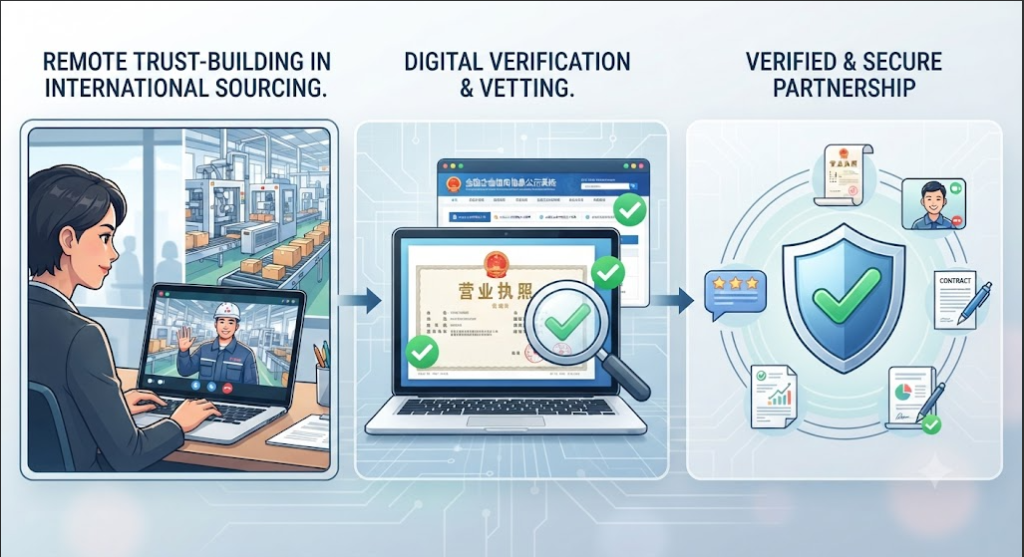
Here's the uncomfortable reality of sourcing from China in 2026:
Most buyers will never meet their supplier in person before wiring a deposit.
Travel budgets are tight. Lead times are short. And for many small and mid-sized buyers, a $3,000 flight to Guangzhou to inspect a $30,000 machine doesn’t make financial sense — especially for a first order.
But that doesn’t mean you’re flying blind.
Over 15 years of China sourcing, we’ve helped hundreds of buyers build trust-at-a-distance with suppliers they’ve never physically met. Some of those relationships are still going strong a decade later.
This guide walks you through the practical, verified steps to assess supplier credibility, protect your deposit, and build a working relationship — all without boarding a plane.
Why "Trust" Matters More When You Can't Visit
When you visit a factory in person, trust builds naturally:
- You see the production floor, the machinery, the inventory
- You meet the owner, the sales manager, the technicians
- You observe how organized (or disorganized) the operation is
- You can read body language, ask follow-up questions, and pressure-test answers in real time
When you can’t visit, you lose all of that. You’re making a five-figure decision based on:
- Email exchanges
- Photos and videos (which could be staged or borrowed)
- Promises in a quote
- Maybe a video call or two
In that environment, trust isn’t automatic — it’s built through verification, transparency, and small tests.
Step 1: Start with Structured Verification (Before You Engage Deeply)
Don’t fall in love with a supplier before you’ve done basic due diligence. Here’s your pre-engagement checklist:
1.1 Business License and Export License
Ask for:
- Business license (营业执照) — confirms they’re a registered legal entity
- Export license — confirms they’re authorized to sell internationally
Red flag: They refuse, delay, or send a blurry/obviously fake document.
How to verify:
- Cross-check the company name and registration number on:
- 国家企业信用信息公示系统 (China National Enterprise Credit Information Publicity System)
- Tianyancha (天眼查) or Qichacha (企查查) — third-party corporate registries (some info is free)
If the company name in the license doesn’t match the name on the quote or website, stop. You may be dealing with a middleman or a shell entity.
1.2 Factory Photos and Videos (Time-Stamped and Customized)
Ask for:
- Recent workshop photos showing:
- Machines being assembled
- Inventory of raw materials and components
- Finished machines awaiting shipment
- A short video walkthrough with a visible sign or paper showing your company name + today’s date
Red flag: Generic photos with no branding, or photos that reverse-image-search to another supplier’s website.
Pro tip: Ask them to send a photo of a specific machine with a piece of paper that says “For [Your Company Name] — [Today’s Date]”. Scammers can’t easily fake this.
1.3 Check Their Export History (If Possible)
If you have access to trade databases (Panjiva, ImportGenius, etc.) or can ask a sourcing agent, check:
- Do they have a track record of actual shipments?
- What volumes? To which countries?
- Are there repeat customers (a sign of reliability)?
Red flag: Zero export history, or all shipments went to one address (possible fake data or in-house transfers).
1.4 Request Customer References
Ask for:
- 2–3 recent customers (ideally in your country or region)
- Contact info (email or WhatsApp)
Then actually contact them. Ask:
- How long have you worked with this supplier?
- Did the machine arrive on time and as specified?
- Any issues during installation or after-sales?
- Would you buy from them again?
Red flag: They can’t (or won’t) provide references. Or the references are evasive or overly scripted (possible fake).
Step 2: Build Rapport Through Transparent Communication
Trust isn’t just about documents — it’s about how the supplier behaves during the negotiation and planning process.
2.1 Responsiveness and Clarity
Good suppliers:
- Reply within 24 hours (accounting for time zones)
- Answer questions directly, without deflecting or over-promising
- Proactively clarify specs, lead times, and terms
Bad suppliers:
- Ghost you for days, then resurface with vague answers
- Dodge technical questions (“Don’t worry, we’ll handle it”)
- Change prices or specs mid-conversation without explanation
2.2 Willingness to Video Call
Insist on at least two video calls before final payment:
Call 1: Introductory (30 min)
- Meet the sales manager (and ideally the owner or technical lead)
- Tour the workshop via smartphone
- Discuss your project in detail
Call 2: Pre-Shipment Inspection (if no third-party inspector)
- See your specific machine running
- Verify serial number, specs, accessories
- Ask questions in real time
Red flag: They refuse video calls, or the “factory” on the call looks like a trade company office with no production equipment.
2.3 Transparency on What They Can't Do
Trustworthy suppliers will tell you:
- “We don’t have CE certification in-house, but we can arrange third-party testing.”
- “Lead time is 60 days, but Chinese New Year is in 4 weeks, so realistically 75 days.”
- “This model works best at 80 ppm; if you need 120 ppm, consider the upgraded version.”
Untrustworthy suppliers will:
- Say “yes” to everything
- Promise delivery dates they can’t meet
- Claim they can do things they’ve never done before
Trust the supplier who sets realistic expectations over the one who promises the moon.
Step 3: Protect Yourself with Smart Payment Terms
Even if you trust the supplier, structure the deal to minimize risk.
3.1 Never Pay 100% Upfront
Standard payment terms for machinery:
- 30% deposit (to start production)
- 70% balance (before shipment, after you or an inspector verify the machine)
Some suppliers push for 50/50 or even 100% upfront. Resist.
Why? Once they have your money and the machine is ready, you have no leverage if something is wrong.
Planning to buy this equipment? Tell us your capacity and budget — we reply within 24 hours.
Get a factory-direct quote on WhatsApp3.2 Use Escrow or Trade Assurance (for First Orders)
Platforms like Alibaba Trade Assurance or third-party escrow services (Payoneer Escrow, Alipay International) hold your payment until you confirm the machine meets the contract terms.
How it works:
- You pay into escrow
- Supplier sees the funds are committed (so they start production)
- Funds release only after you (or your inspector) confirm the machine is correct
Cost: Usually 1–3% of order value. Worth it for a $30,000+ machine when you’ve never worked with the supplier before.
3.3 Include Penalty Clauses in the Contract
Your contract should specify:
- Late delivery penalty (e.g., 0.5% of order value per week, capped at 5%)
- Non-conformance penalty (e.g., machine fails agreed specs → partial refund or free remediation)
- Warranty terms (12 months from installation, not from shipment)
Most suppliers will accept reasonable penalties. If they refuse, it’s a sign they’re not confident in their own delivery.
Step 4: Test the Relationship with a Small Order (If Possible)
If you're planning a large multi-machine investment, consider starting with:
- A smaller auxiliary machine (e.g., a sealing machine before the full VFFS line)
- A trial/pilot unit (semi-auto version before committing to full-auto)
This lets you:
- Test their communication and delivery
- Evaluate quality and after-sales support
- Build mutual trust before the big order
Yes, you’ll pay slightly more per unit. But you’ll sleep better at night.
Step 5: Verify Before You Release Final Payment
Before you pay the 70% balance, someone must physically verify the machine. Options:
Option A: Third-Party Inspection
Hire an independent inspector (SGS, TÜV, AsiaInspection, or a freelance engineer) to visit the factory and check:
- Machine matches the agreed specs
- All accessories and spare parts are included
- Machine runs correctly (test with actual product, if possible)
- Packaging is adequate for international shipping
Cost: $300–$800 depending on complexity and location.
ROI: Prevents shipping a $40,000 lemon.
Option B: Video Inspection (If Budget Is Tight)
If you can’t afford a third-party inspector, insist on a live video inspection via WhatsApp/WeChat/Zoom:
- Ask them to show the machine running (not a pre-recorded video — you control the camera angle)
- Verify the serial number on the machine matches your PO
- Ask them to demonstrate specific functions
Not as good as in-person inspection, but better than nothing.
Option C: Factory Acceptance Test (FAT) — For High-Value Orders
For machines over $50,000 or complex custom equipment, negotiate a formal FAT:
- You (or your engineer/agent) visit the factory
- Supplier runs the machine through a test protocol you both agreed on in advance
- You sign off on performance before shipment
Cost: Airfare + hotel + time. But for a $100,000 machine, it’s a small insurance premium.
Step 6: After-Sales Support = Long-Term Trust
The real test of trust comes after the machine is installed.
What to demand upfront:
- Installation and training (on-site or remote, depending on contract)
- Spare parts list and pricing (so you’re not held hostage later)
- Technical support contact (WhatsApp, WeChat, or email) with guaranteed response time
- Warranty terms in writing (12 months from commissioning, not from shipment)
Red flags after the sale:
- Supplier becomes unresponsive once they’ve been paid
- Spare parts take 8 weeks to ship (or are suddenly 3× the quoted price)
- They blame all problems on “user error” and refuse to help
Good suppliers treat the first sale as the start of a relationship, not the end. They want you to come back for spare parts, upgrades, and referrals.
When Should You Actually Visit the Factory?
You don't always need to. But consider visiting if:
- The order is >$100,000
- It’s a custom or semi-custom machine (not a standard model)
- You’re planning a long-term partnership (multiple machines over several years)
- You’ve had multiple email red flags and want to de-risk before committing
- You’re in the region anyway (e.g., attending a trade show in Guangzhou or Shanghai)
Pro tip: If you do visit, go unannounced (or with only 24 hours notice). Factories can stage a lot in a week, but they can’t fake an entire operation overnight.
Red Flags That Mean "Walk Away"
No matter how good the price, do not proceed if:
- They refuse to provide a business license or export license
- Their “factory” can’t show you a live video of machines being assembled
- They demand 100% payment upfront with no inspection
- They have zero export history and zero customer references
- They won’t sign a written contract
- They pressure you to “pay now before the price goes up”
- Their English is too good (possible scam account, not a real factory)
- They offer prices 40–50% below market (if it’s too good to be true, it is)
Trust your gut. If something feels off, it probably is.
How Sourcing Agents Solve the Trust Problem
This is why many buyers work with China sourcing agents:
- The agent has already vetted the factory (visited, audited, worked with them before)
- The agent manages communication, QC, and logistics in Chinese
- The agent’s reputation is on the line — they won’t introduce you to a scammer
- If something goes wrong, the agent has local leverage (and can visit the factory in person)
Cost: Typically 5–10% of order value.
ROI: Peace of mind, especially on first orders or high-value equipment.
Final Checklist: Building Trust Without Meeting
Before you wire that deposit, verify:
- [ ] Business license checked on official Chinese registry
- [ ] Factory photos/video with your company name + today’s date
- [ ] At least one video call with factory tour
- [ ] 2–3 customer references contacted
- [ ] Payment terms are 30/70 (not 100% upfront)
- [ ] Written contract with penalties for late delivery or non-conformance
- [ ] Pre-shipment inspection arranged (third-party or video)
- [ ] After-sales support and spare parts terms in writing
If you can check all 8 boxes, you’ve done more due diligence than 80% of buyers. You’ll never eliminate risk entirely, but you’ve reduced it to an acceptable level.
Conclusion
You don’t need to meet your Chinese supplier in person to build trust — but you do need to be intentional about it.
Trust isn’t built on a handshake or a factory tour. It’s built on:
- Verification (documents, references, video proof)
- Transparency (honest communication, realistic promises)
- Accountability (written contracts, inspection, penalties)
- Consistency (responsive after-sales support)
The suppliers who pass these tests are the ones worth doing business with — whether you’ve met them in person or not.
Need help vetting a Chinese supplier or negotiating safer payment terms? Contact us — we’ve been building trust across borders for 15 years.
Related Equipment
Need a price, spec sheet or a pre-shipment factory inspection? Message us directly.
Get a factory-direct quote on WhatsAppWhatsApp: +852 9702 5284 · +86 158 7238 6392