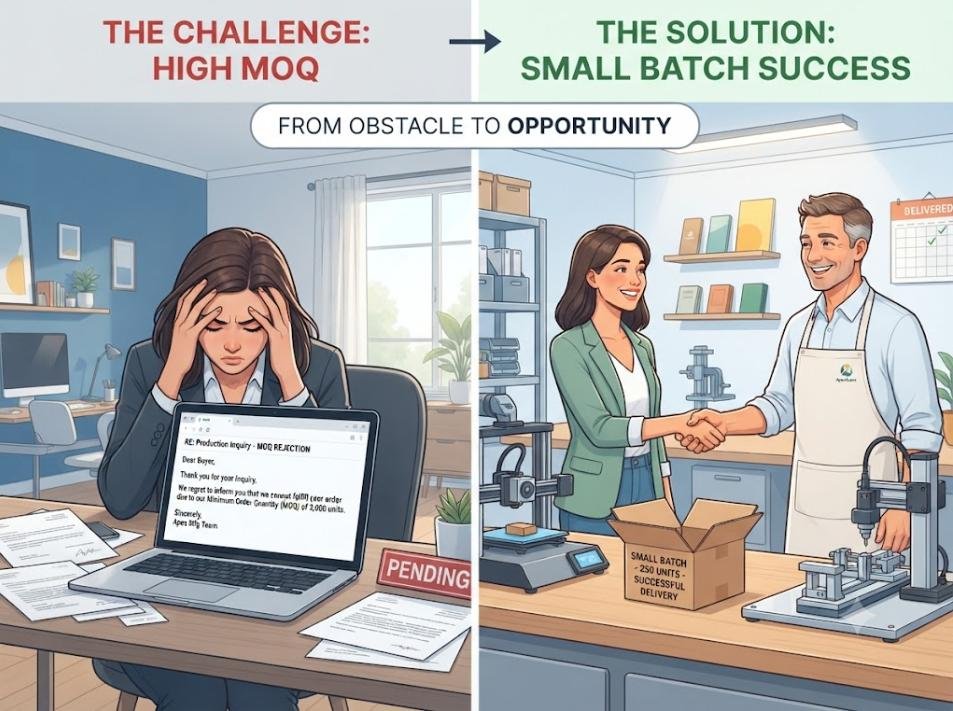
If you’ve ever tried to source a product from China in small quantities, you’ve probably heard this response:
“Sorry, our MOQ is 5,000 pieces. We cannot accept orders below this quantity.”
It’s frustrating—especially when you’re testing a new product, launching a startup, or running a small brand that doesn’t need (or can’t afford) thousands of units upfront.
So why do Chinese suppliers reject small orders? And more importantly, how can you work around it?
After five years working with manufacturers and buyers across multiple industries, here’s what I’ve learned about making small-batch sourcing work.
Why Most Chinese Factories Say No to Small Orders
It’s not personal—it’s economics.
- Setup Costs Don’t Scale Down
Whether a factory produces 500 units or 5,000 units, they still need to:
- Set up the production line
- Program the machines
- Create molds or tooling (if it’s a custom product)
- Train workers on your specific product specs
- Run quality checks and packaging
These fixed costs get spread across the order quantity. At 5,000 units, setup might add $0.50 per unit. At 500 units, it’s $5.00 per unit—making the product unaffordably expensive or unprofitable for the factory.
- Opportunity Cost: They’d Rather Run Bigger Orders
A factory with limited production capacity will prioritize orders that maximize revenue per production day. A 500-unit order might take the same machine time as a 5,000-unit order, but generates 10x less revenue.
So unless it’s a slow season, small orders get pushed to the back of the queue—or rejected entirely.
- Export Minimums and Shipping Economics
Shipping a full container (FCL) from China is far cheaper per unit than shipping a small batch via air or LCL (less than container load). Many factories don’t want to deal with the logistics complexity of small shipments, especially if the buyer is new and inexperienced. So How Do You Source Small Batches from China?
It’s harder than placing a big order—but it’s absolutely possible if you know where to look and how to structure the deal.
Strategy 1: Work with Trading Companies or Sourcing Agents (Not Factories)
Trading companies and sourcing agents are middlemen—but in the case of small orders, that’s exactly what you need.
They aggregate small orders from multiple buyers and place a single large order with the factory. You pay a markup (typically 10–20%), but you get access to factory pricing and quality without hitting the MOQ wall.
When this works:
- You’re ordering standard or semi-custom products (not highly specialized)
- You’re willing to accept slightly longer lead times (since they may batch your order with others)
- You want someone to handle factory communication, QC, and logistics on your behalf
When this doesn't work:
- You need a fully custom product with unique tooling
- You’re ordering something highly technical that requires direct factory collaboration Strategy 2: Find Factories That Specialize in Small Batches
Not all Chinese manufacturers chase high-volume orders. Some factories deliberately target small and medium buyers—especially in industries like:
Planning to buy this equipment? Tell us your capacity and budget — we reply within 24 hours.
Get a factory-direct quote on WhatsApp- Custom packaging
- Promotional products
- Private-label cosmetics or supplements
- Prototyping and product development
These factories have flexible production lines, lower fixed costs, and are set up to handle frequent changeovers between different clients’ products.
How to find them:
- Search Alibaba for suppliers with “Low MOQ” or “Small Orders Accepted” badges
- Look for suppliers in Guangdong or Zhejiang provinces (these regions have more flexible small-batch manufacturers)
- Ask your network—other small business owners who’ve successfully sourced in small quantities
Trade-off:
You’ll pay a higher per-unit price than a buyer ordering 10,000 units. But you avoid the cash flow risk of overordering, and you can test the market before committing to large inventory.
Strategy 3: Offer to Pay a Setup Fee
If you find a factory you really want to work with, but they’re hesitant about your small order, offer to pay a one-time setup fee to cover their fixed costs.
For example:
- Their normal price at 5,000 units: $4.00/unit
- Their price at 500 units without setup fee: $8.00/unit (not viable for you)
- Your proposal: $5.00/unit + $500 setup fee = $3,000 total for 500 units
This makes the deal profitable for them and keeps your per-unit cost reasonable.
When to use this:
- You’ve found the perfect factory for your product
- You plan to reorder in larger quantities once you validate demand
- The setup fee is a one-time cost (future orders won’t require it) Strategy 4: Use a Sourcing Agent to Navigate the Process
If you’re new to China sourcing, don’t have time to vet suppliers, or want someone to negotiate on your behalf, hiring a sourcing agent can save you weeks of trial and error.
A good agent will:
- Identify factories that accept small orders in your product category
- Negotiate pricing and MOQs on your behalf
- Arrange samples, quality inspections, and shipping
- Act as a bridge between you and the factory (language, culture, expectations)
Cost:
Agents typically charge 5–15% of order value, or a flat project fee. For small orders, this markup is often worth it to avoid costly mistakes.
What About Risk? How Do You Avoid Getting Scammed on a Small Order?
Small orders are actually higher risk than large orders, because:
- You have less leverage to demand quality
- Some suppliers see small buyers as “one-time customers” and cut corners
- It’s harder to justify the cost of third-party inspections on a $2,000 order
How to protect yourself:
- Always order samples before placing a production order. Don’t skip this step, even if it costs $100–$200. The sample quality tells you whether the factory can deliver.
- Check the supplier’s credentials. Look for:
- Verified Alibaba Gold Supplier status
- Trade Assurance coverage
- Factory audit reports (if available)
- Get a second opinion on the quotation and contract. Before you send a deposit, have someone with supply-side experience review the deal for red flags.
We offer a $99 Supplier Risk Check service specifically for this: you send us the supplier’s quotation, Proforma Invoice, Alibaba link, and any contracts or certificates, and we check for common warning signs within 24–48 hours.
It’s a small investment that can save you from losing your deposit or receiving unusable products.
Final Thought: Small Orders Are Possible—But You Have to Be Strategic
You won’t get the same pricing or priority as a buyer ordering 10,000 units. But if you:
- Work with the right suppliers (trading companies, small-batch specialists, or sourcing agents)
- Structure the deal to make it profitable for the factory
- Protect yourself with samples, vetting, and contracts
…then small-batch sourcing from China is absolutely viable.
And once you validate demand and grow your order size, you’ll unlock better pricing and terms. You just have to start smart.
If you’re trying to place a small order and need help finding the right supplier, negotiating MOQs, or reviewing a quotation for red flags, reach out.
Related Equipment
Need a price, spec sheet or a pre-shipment factory inspection? Message us directly.
Get a factory-direct quote on WhatsAppWhatsApp: +852 9702 5284 · +86 158 7238 6392