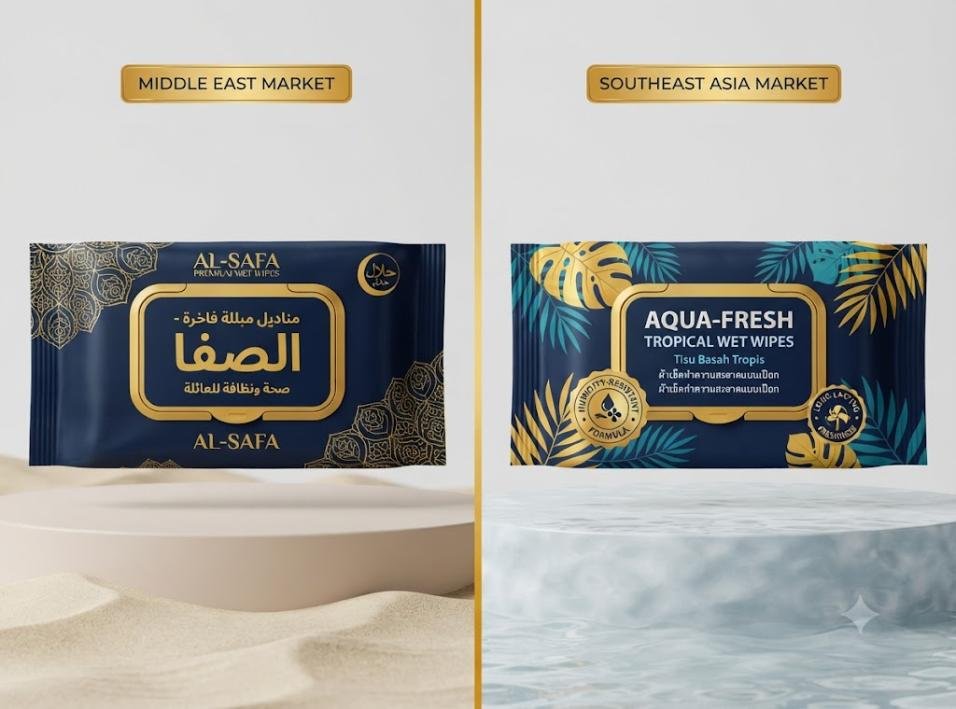
If you’re manufacturing wet wipes for export, Southeast Asia and the Middle East are two of the most attractive growth markets right now.
Both regions have young populations, rising disposable incomes, and growing demand for hygiene products. But that’s where the similarities end.
The product strategies that work in Jakarta or Manila often fail in Riyadh or Dubai—and vice versa.
I’ve worked with manufacturers who’ve successfully entered both markets, and I’ve seen others waste time and money trying to sell the same product in both regions without adapting.
Here’s what you need to know about each market—and how to adjust your product line, packaging, and positioning to succeed in each.
Market overview: Size, growth, and opportunity
Southeast Asia
Key markets: Indonesia, Philippines, Vietnam, Thailand, Malaysia
Population: ~680 million (Indonesia alone has 275 million)
Growth drivers:
- Rapid urbanization (more people moving to cities with modern retail)
- Rising middle class with increasing purchasing power
- High birth rates (strong demand for baby wipes)
- Hot, humid climate (drives demand for personal hygiene and freshness products)
Market maturity: Developing. Modern retail is growing fast, but traditional trade (small shops, street vendors) still dominates in many areas.
Middle East / GCC
Key markets: Saudi Arabia, UAE, Qatar, Kuwait, Bahrain, Oman
Population: ~57 million in GCC countries (smaller, but wealthier)
Growth drivers:
- High per-capita income (among the highest in the world)
- Large expatriate populations (diverse consumer preferences)
- Strong demand for premium and halal-certified products
- Hot, dry climate (emphasis on cleanliness and hygiene)
Market maturity: More developed. Modern retail (hypermarkets, supermarkets, e-commerce) is well-established.
Key difference: Southeast Asia is a volume game. The Middle East is a value game. You’ll sell more units in Southeast Asia, but often at lower margins. You’ll sell fewer units in the Middle East, but often at premium prices.
Product differences: What each market expects
- Formulation and ingredients
Southeast Asia:
- Fragrance preferences: Light, fresh scents (citrus, aloe, green tea). Avoid heavy perfumes.
- Moisture level: High moisture content is acceptable and often preferred (humid climate means products don’t dry out quickly).
- Natural/herbal ingredients: Growing demand, especially in Thailand and Vietnam. Emphasize botanical extracts if you have them.
- Alcohol content: Generally acceptable for antibacterial wipes. Some markets (like Indonesia with a large Muslim population) prefer alcohol-free, but it’s not as strict as the Middle East.
Middle East:
- Fragrance preferences: Neutral or lightly scented. Some consumers prefer unscented for religious reasons. Rose and oud scents work well for premium lines.
- Moisture level: Moderate. Too much moisture can be perceived as wasteful or uncomfortable in a dry climate.
- Halal certification: Critical. Even if the ingredients are inherently halal, certification signals trust and compliance.
- Alcohol-free: Mandatory for any product marketed to Muslim consumers. Make this prominently visible on packaging.
Bottom line: If you’re using the same formulation for both markets, at minimum make sure it’s alcohol-free (to work in the Middle East) and adjust fragrance intensity (lighter for Southeast Asia, neutral for Middle East).
- Pack size and count
Southeast Asia:
- Smaller pack sizes (10-20 wipes) are popular because:
- Lower price points fit tight budgets
- High humidity means larger packs can dry out or get contaminated before use
- Consumers shop more frequently in smaller quantities (traditional trade model)
- Sachet format (single-use wipes in tear-open pouches) is huge in this market. It’s the most affordable entry point and fits the “buy small, buy often” shopping behavior.
Middle East:
- Larger pack sizes (50-100 wipes) are preferred because:
- Higher purchasing power means consumers buy in bulk
- Dry climate means larger packs don’t dry out as fast
- Modern retail (hypermarkets) encourages bulk buying
- Multipacks (bundles of 3, 5, or 10 packs) are popular for household use.
Bottom line: If you’re targeting both markets, you’ll likely need at least two SKUs: small packs (10-20 count) for Southeast Asia, and large packs (50-100 count) for the Middle East.
- Packaging and labeling
Southeast Asia:
- Language: Multilingual packaging helps (English + local language like Bahasa Indonesia, Tagalog, Vietnamese, Thai). English alone works in urban areas but limits rural reach.
- Design: Bright, colorful, friendly. Emphasize freshness, natural ingredients, and value.
- Price visibility: Consumers are price-sensitive. If your product offers good value, communicate it clearly.
- Regulatory: Varies by country. Indonesia and Thailand have specific labeling requirements (ingredient lists, usage instructions, manufacturer info).
Middle East:
- Language: Arabic is essential. English is widely understood, but Arabic on the front panel signals that the product is designed for this market (not just exported generically).
- Design: Clean, premium, sophisticated. Emphasize quality, safety, and trust. Gold accents and minimalist designs work well.
- Halal certification logo: Must be prominently displayed. GCC consumers actively look for it.
- Regulatory: GCC countries have strict standards (GSO for cosmetics and hygiene products). Make sure your packaging meets them before entering the market.
Bottom line: Don’t just slap a translated label on the same packaging. Design for each market with culturally relevant visuals and messaging.
- Product categories and use cases
Southeast Asia:
- Baby wipes: Huge category. High birth rates and growing middle class = strong demand.
- Personal hygiene wipes: Popular for freshness throughout the day (hot, humid climate).
- Antibacterial/sanitizing wipes: Grew significantly post-COVID and remains strong.
- Makeup remover wipes: Growing in urban areas (rising beauty and skincare consciousness).
- Kitchen/household cleaning wipes: Emerging category, but not as developed as personal care.
Middle East:
- Baby wipes: Strong demand, but market is competitive and dominated by established brands (focus on differentiation).
- Intimate hygiene wipes: Important category, especially for women. Alcohol-free and pH-balanced formulas are key.
- Antibacterial wipes: High demand. Cleanliness is culturally and religiously important.
- Luxury/premium wipes: A segment that barely exists in Southeast Asia. High-end wipes with silk extracts, premium fragrances, and elegant packaging can command premium prices here.
- Portable wipes for travel: The GCC has high car ownership and frequent travel, so individually wrapped wipes for on-the-go use are popular.
Bottom line: Both markets want baby wipes and antibacterial wipes. But the Middle East has unique opportunities in premium and intimate hygiene categories that are harder to monetize in Southeast Asia.
Pricing and positioning strategy
Southeast Asia: Volume and value
Consumer mindset: Price-conscious. Many consumers are buying wet wipes for the first time and are choosing between your product and cheaper alternatives (or not buying at all).
Positioning strategy:
- Emphasize value: “affordable quality,” “trusted brand,” “safe for families”
- Compete on price (but don’t race to the bottom—cheap products have quality issues and hurt your brand)
- Use smaller pack sizes and sachets to lower the entry price
- Distribution through traditional trade (small shops, street vendors) is critical to reach rural and lower-income consumers
Pricing benchmark: Baby wipes in Indonesia might retail for $1.50-$3.00 for a 50-count pack. In the Philippines, a 10-pack sachet might sell for $0.30-$0.50.
Middle East: Premium and trust
Consumer mindset: Quality-conscious. Consumers have disposable income and are willing to pay more for products that signal quality, safety, and status.
Positioning strategy:
- Emphasize quality: “dermatologically tested,” “certified halal,” “premium ingredients,” “trusted by families”
- Premium packaging and branding matter (consumers judge quality by appearance)
- Larger pack sizes and multipacks fit the shopping behavior
- Distribution through modern retail (hypermarkets, supermarkets, pharmacies, e-commerce) is dominant
Pricing benchmark: Baby wipes in the UAE might retail for $4-$8 for a 60-80 count pack. Premium wipes can go higher ($10-$15 for luxury brands).
Bottom line: In Southeast Asia, compete on affordable quality. In the Middle East, compete on premium quality and trust.
Distribution and retail channels
Southeast Asia
Traditional trade dominates: Small neighborhood shops (called warung in Indonesia, sari-sari stores in the Philippines) account for the majority of consumer goods sales in many Southeast Asian markets.
What this means for you:
- You need distributors with deep networks into traditional trade (not just modern retail)
- Smaller pack sizes and sachets are easier for small shops to stock and sell
- Cash-on-delivery and flexible payment terms are often necessary for distributors
Modern retail is growing fast: Hypermarkets, convenience stores (7-Eleven, Indomaret, Alfamart), and e-commerce (Shopee, Lazada, Tokopedia) are expanding rapidly, especially in urban areas.
E-commerce tip: Online shopping is booming in Southeast Asia, especially post-COVID. Having a presence on Shopee and Lazada can significantly boost reach.
Middle East
Modern retail dominates: Hypermarkets (Carrefour, Lulu, Géant), supermarkets, and pharmacies are the main channels.
What this means for you:
- You need distributors with relationships with major retail chains
- Larger pack sizes and premium packaging fit the retail environment
- Retail buyers expect certifications (halal, GSO compliance) and strong branding
E-commerce is growing: Online retail (Noon, Amazon.ae, Carrefour online) is significant and growing, especially in UAE and Saudi Arabia.
B2B opportunities: Hotels, hospitals, and corporate buyers in the GCC purchase wet wipes in bulk. This is a channel worth exploring if you can meet volume and compliance requirements.
Planning to buy this equipment? Tell us your capacity and budget — we reply within 24 hours.
Get a factory-direct quote on WhatsAppRegulatory and certification requirements
Southeast Asia
Regulatory requirements vary significantly by country.
Indonesia:
- Registration with BPOM (Food and Drug Monitoring Agency)
- Halal certification (from MUI) is not legally required for wet wipes, but it’s a strong market advantage given the 87% Muslim population
Philippines:
- FDA registration required for cosmetics and personal care products
- GMP certification is a plus
Thailand:
- FDA notification required
- Labeling in Thai language required for retail sale
Vietnam:
- Notification or registration with the Ministry of Health depending on product claims
- Labeling in Vietnamese required
Malaysia:
- Registration with the National Pharmaceutical Regulatory Agency (NPRA) if product makes cosmetic or drug claims
- Halal certification (from JAKIM) strongly preferred
Bottom line: Budget time and money for country-specific registrations. Work with a local distributor or regulatory consultant to navigate this.
Middle East / GCC
GSO (Gulf Standardization Organization) standards apply across the GCC and cover cosmetics, personal care, and hygiene products.
Key requirements:
- Halal certification (usually from a recognized body like ESMA in UAE, SFDA in Saudi Arabia, or international bodies like Halal International)
- Ingredient disclosure and safety data
- Arabic labeling (ingredients, usage instructions, warnings, expiration date, manufacturer info)
- Compliance with GSO 1943 (cosmetics and personal care products)
Country-specific:
- UAE: Register with ESMA (Emirates Authority for Standardization and Metrology)
- Saudi Arabia: Register with SFDA (Saudi Food and Drug Authority)
- Qatar, Kuwait, Bahrain, Oman: Each has its own regulatory body, but they largely follow GSO standards
Bottom line: Halal certification and GSO compliance are non-negotiable. Don’t enter this market without them.
Cultural and religious considerations
Southeast Asia
Religion: Predominantly Muslim in Indonesia, Malaysia, and Brunei. Predominantly Catholic in the Philippines. Predominantly Buddhist in Thailand, Vietnam, Cambodia, Myanmar.
What this means for wet wipes:
- Halal certification is a strong advantage in Indonesia and Malaysia, but not mandatory (unlike the Middle East)
- Avoid pork-derived ingredients (gelatin, glycerin from pork) in Muslim-majority countries
- Religious imagery should be neutral or avoided
Cultural preferences:
- Family-oriented messaging works well across the region
- Value and affordability resonate strongly
- Trust in “imported” or “international” brands is high, but local brands are gaining ground Middle East
Religion: Predominantly Muslim (Sunni in most GCC countries).
What this means for wet wipes:
- Halal certification is not optional—it’s expected
- Alcohol-free formulation is mandatory for consumer acceptance
- Modest, family-friendly imagery is important (avoid overly revealing images)
- Cleanliness and hygiene are religiously significant (Islam emphasizes taharah, or purity)
Cultural preferences:
- Premium quality and brand reputation are highly valued
- Family and children are central to consumer identity
- Arabic language signals respect and seriousness about the market How to adapt your product line for both markets
If you want to serve both Southeast Asia and the Middle East, here’s a practical approach:
Option 1: Shared base product with regional variants
- Base formula: Alcohol-free, dermatologically tested, made with halal-compliant ingredients
- Southeast Asia variant: Smaller pack sizes (10-20 count), bright packaging, multilingual labels (English + local language), lighter fragrance
- Middle East variant: Larger pack sizes (50-100 count), premium packaging, Arabic + English labels, neutral or no fragrance, halal certification logo
This approach minimizes production complexity while allowing you to address regional preferences.
Option 2: Separate product lines for each market
If your production capacity and budget allow, develop distinct product lines:
- Southeast Asia line: Focus on affordability, value packs, sachets, and everyday use cases (baby, antibacterial, freshness)
- Middle East line: Focus on premium quality, larger packs, multipacks, and specialized categories (intimate hygiene, luxury, travel-size)
This approach maximizes market fit but requires more investment in R&D, branding, and inventory management.
Common mistakes manufacturers make
Mistake 1: Using the same product and packaging for both markets
“I’ll just print the label in Arabic and English and sell it everywhere.”
This rarely works. Consumers in each market can tell when a product wasn’t designed for them—and they’ll choose a competitor who got it right.
Mistake 2: Entering the Middle East without halal certification
Some manufacturers think, "The ingredients are halal, so I don't need certification."
Wrong. The certification isn’t just about ingredients—it’s about trust, compliance, and signaling that you take this market seriously.
Mistake 3: Underestimating regulatory timelines
Getting product registrations in Southeast Asia (BPOM, FDA, etc.) and the Middle East (GSO, ESMA, SFDA) can take 3-6 months or longer.
Don’t assume you can launch next month. Build regulatory timelines into your go-to-market plan.
Mistake 4: Ignoring distribution realities
“I’ll just list my product on Amazon and Shopee and let it sell.”
E-commerce helps, but in both regions, strong distributor relationships are critical—especially for getting your product into traditional trade (Southeast Asia) or major retail chains (Middle East).
How we help manufacturers enter these markets
At Zhenbao Trading, we work with wet wipes manufacturers who want to enter Southeast Asia and Middle East markets but don’t have local expertise.
We help with:
- Product adaptation strategy (formulation, packaging, sizing)
- Regulatory compliance (halal certification, GSO, BPOM, FDA)
- Distributor introductions and vetting
- Market entry planning and go-to-market strategy
We’ve worked with manufacturers across Russia, Tajikistan, and other markets who’ve successfully launched in both regions.
If you’re considering expanding into Southeast Asia or the Middle East, let’s talk about what it takes to succeed in each market.
Contact: sales@zhenbaotrading.com | WhatsApp: +852 9702 5284
Related Equipment
Need a price, spec sheet or a pre-shipment factory inspection? Message us directly.
Get a factory-direct quote on WhatsAppWhatsApp: +852 9702 5284 · +86 158 7238 6392