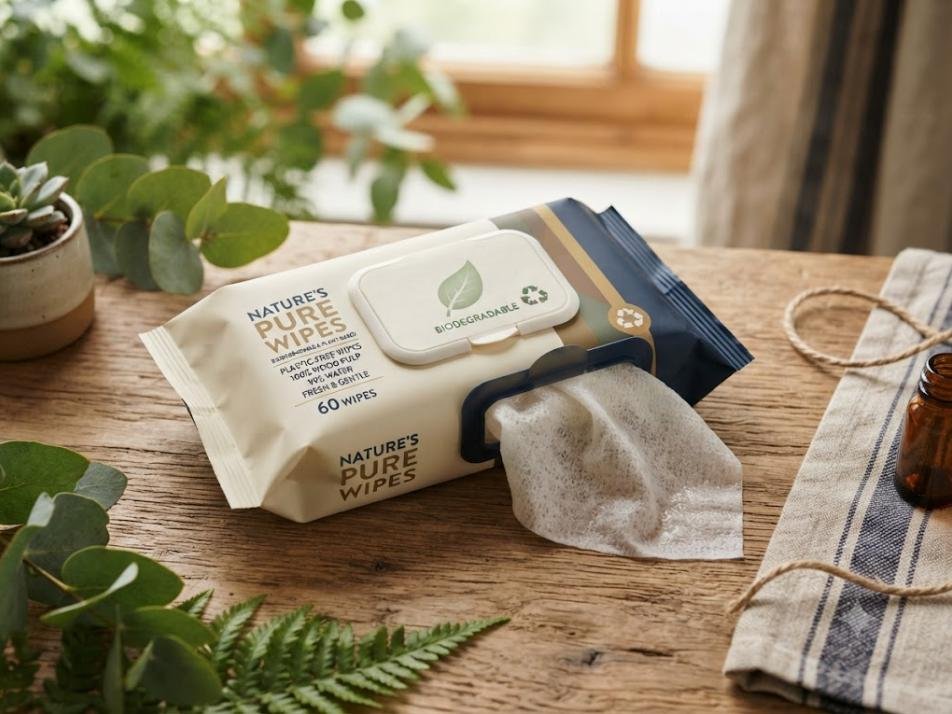
Biodegradable wet wipes are no longer a niche product. Driven by regulatory pressure, consumer preference, and corporate sustainability commitments, the shift toward eco-friendly wipes is accelerating—and it’s reshaping what buyers need from their production equipment.
If you’re manufacturing wet wipes or evaluating machinery investments, understanding the biodegradable segment isn’t optional anymore. It’s a market reality that will affect your material sourcing, machine configuration, and competitive positioning.
After 15 years helping buyers source wet wipes machinery and navigate supply-side trends, I’ve watched this transition unfold. Here’s what the biodegradable shift means for your production line—and what you need to know before you commit to equipment.
Why Biodegradable Wet Wipes Are Growing Fast
- Regulatory Pressure
Governments are cracking down on single-use plastics and non-degradable hygiene products:
- EU Single-Use Plastics Directive: Targets products that contribute to marine pollution, including plastic-containing wipes
- UK “Fine to Flush” Standard: Only wipes that pass water industry flushability tests can carry this label
- California SB 1046 (2024): Bans marketing wipes as “flushable” unless they meet strict biodegradability criteria
- Extended Producer Responsibility (EPR) schemes: Manufacturers are increasingly liable for end-of-life disposal costs
Translation for manufacturers: If your wipes contain polyester or polypropylene (common in conventional non-woven fabric), you may face market restrictions, higher disposal fees, or outright bans in certain regions.
- Consumer Demand
Sustainability claims are no longer just marketing fluff—buyers are checking labels:
- 73% of global consumers say they would change their consumption habits to reduce environmental impact (Nielsen)
- “Biodegradable” and “plastic-free” are top search terms for wet wipes on e-commerce platforms
- Retailers (especially in EU and North America) are prioritizing eco-friendly brands on shelf space
- Corporate Commitments
Major CPG brands (P&G, Kimberly-Clark, Unicharm) have set 2030 sustainability targets that include phasing out non-biodegradable materials in wipes. If you’re a private-label or contract manufacturer, your customers will soon require biodegradable options.
What Makes a Wet Wipe “Biodegradable”?
Not all wipes marketed as “biodegradable” are the same. Here’s what actually matters:
Material Composition
Biodegradable non-woven fabrics:
✓ 100% Viscose (Rayon): Derived from wood pulp, breaks down in composting or wastewater
✓ 100% Lyocell (Tencel): Similar to viscose but produced via a more sustainable closed-loop process
✓ Wood Pulp Airlaid: Used in flushable wipes, breaks down quickly in water
✓ Bamboo or Cotton Blends: Natural fibers, but more expensive
Non-biodegradable materials to avoid:
❌ Polyester (PET, PES)
❌ Polypropylene (PP)
❌ Any synthetic blends (e.g., 50/50 viscose/polyester)
Key point: Even a 30% polyester blend disqualifies a wipe from being truly biodegradable. The synthetic fibers don’t break down, leaving microplastic residue.
Liquid Solution (Often Overlooked)
The non-woven substrate isn’t the only factor. The liquid solution must also be biodegradable:
✓ Water-based formulas
✓ Plant-derived surfactants and preservatives
✓ No silicones, mineral oils, or synthetic polymers
If you’re using conventional wipes solution with plasticizers or non-degradable emulsifiers, your “biodegradable wipe” claim won’t hold up under scrutiny.
Packaging
True eco-friendly wipes also consider packaging:
✓ Recyclable or compostable film (e.g., PLA-based flow wrap)
✓ Plastic-free labels and adhesives
✓ FSC-certified paper outer cartons
This adds complexity to your packaging line, but it’s increasingly non-negotiable for premium eco-brands.
How Biodegradable Material Choices Affect Your Production Line
Switching to biodegradable wipes isn’t just a material swap. It has implications for your machinery setup, production process, and cost structure.
- Machine Compatibility
Most modern wet wipes machines can handle 100% viscose or lyocell fabric—but not all.
Check with your supplier:
- Tension control: Natural fiber fabrics can be more delicate than synthetic blends; your unwinding and tensioning systems need to accommodate this
- Cutting blade sharpness: 100% viscose can be softer and may require blade adjustments to avoid fraying
- Sealing temperature: If you’re using biodegradable packaging film (PLA), sealing temperature and dwell time differ from conventional PE or PP film
Bottom line: If you’re buying a new machine, specify upfront that you plan to run biodegradable materials. Some older or lower-cost machines aren’t optimized for this.
- Material Cost
Biodegradable non-woven fabric is more expensive than conventional blends.
Typical cost comparison (per ton):
| Material | Approximate Cost (USD/ton) |
|---|---|
| 50/50 Viscose/Polyester Spunlace | $2,500–3,200 |
| 100% Viscose Spunlace | $3,500–4,500 |
| Lyocell (Tencel) | $4,500–5,500 |
| Wood Pulp Airlaid (flushable) | $3,200–4,200 |
Impact on cost per wipe:
Switching from a 50/50 blend to 100% viscose adds roughly $0.008–0.012 per wipe. Small per unit, but it compounds across millions of wipes.
Can you pass this cost to consumers? In premium and eco-conscious markets (EU, North America, Australia), yes. In ultra-price-sensitive markets, it’s harder.
- Flushability Requirements (If Applicable)
If you want to claim “flushable,” biodegradability alone isn’t enough. Flushable wipes must:
Planning to buy this equipment? Tell us your capacity and budget — we reply within 24 hours.
Get a factory-direct quote on WhatsApp✓ Break apart in water within a specified time (e.g., UK Water Industry standard: disintegrate within 4 hours)
✓ Pass through wastewater treatment systems without clogging
✓ Be free of plastics and synthetic binders
Production implications:
- Use wood pulp airlaid or specially engineered viscose
- Avoid latex or synthetic binders in the fabric
- Reduce liquid saturation ratio (too much liquid prevents breakdown)
- Consider perforations or weaker cross-direction strength (engineered to break apart)
Machine adjustments:
Some flushable wipes lines use mechanical perforation or partial cutting to create intentional weak points that help wipes disperse in water. Your machine needs this capability if you’re targeting the flushable segment.
- Certification and Testing
Biodegradable and flushable claims require third-party testing and certification:
✓ EN 13432 (EU): Industrial composting standard
✓ ASTM D6400 (US): Compostability standard
✓ Fine to Flush (UK Water Industry): Flushability standard
✓ TÜV OK Biodegradable: Independent certification for biodegradability
Cost: Testing and certification can run $5,000–15,000 per product variant. Factor this into your product development budget.
Machine consideration: If you’re running multiple product lines (biodegradable and conventional), cross-contamination becomes a risk. You may need dedicated production runs or thorough cleaning protocols to maintain certification.
Market Positioning: Should You Enter the Biodegradable Segment?
Not every wipes manufacturer needs to go biodegradable immediately—but you should evaluate whether it makes strategic sense.
✅ Consider Biodegradable If:
- You’re targeting EU, UK, North America, Australia (high regulatory and consumer pressure)
- Your customers are retail chains or CPG brands with sustainability commitments
- You’re launching a premium or eco-focused brand
- You want to differentiate in a crowded market ⏸ You Can Wait If:
- You’re focused on price-sensitive emerging markets (Southeast Asia, parts of Africa, Latin America) where biodegradable demand is still nascent
- You’re manufacturing industrial or B2B wipes (less consumer-facing, lower eco-pressure)
- Your customers haven’t requested it yet, and local regulations don’t require it
But: Even in price-sensitive markets, regulations are tightening. If you’re buying machinery now, choose equipment that can handle biodegradable materials, even if you don’t use them immediately. Future-proofing is cheaper than replacing your entire line in 3 years.
How to Future-Proof Your Wet Wipes Machinery for Biodegradable Production
If you’re buying new equipment—or evaluating whether your current line can adapt—ask these questions:
- Can the machine handle 100% viscose or lyocell fabric?
Request a production trial with biodegradable material before you commit to a purchase.
- Is the sealing system compatible with biodegradable packaging film?
If you plan to use PLA or other compostable films, verify that your heat-sealing unit can adjust temperature and pressure accordingly.
- Does the machine support lower liquid saturation ratios?
Flushable wipes require less liquid saturation (typically 1:2 to 1:2.5 fabric-to-liquid ratio vs 1:3+ for conventional wipes). Your dosing system needs precision control.
- Can you add perforation or partial cutting?
If flushability is a future goal, check whether your cutting unit can be upgraded to add perforations.
- Is there a cleaning/changeover protocol for mixed production?
If you’ll run both conventional and biodegradable wipes, ask your supplier how to prevent cross-contamination (critical for certification).
Common Mistakes When Entering the Biodegradable Wipes Market
❌ Assuming your current machine can handle biodegradable materials without testing
Run trials first. Some machines struggle with 100% natural fiber fabrics.
❌ Using “biodegradable” as a marketing term without certification
Greenwashing invites regulatory fines and reputational damage. Get third-party testing.
❌ Underestimating the cost impact
Biodegradable materials and certification add 15-25% to production cost. Make sure your pricing and positioning support this.
❌ Ignoring the liquid formula
A biodegradable wipe with a non-biodegradable solution is still not eco-friendly.
❌ Claiming “flushable” without meeting water industry standards
Flushability is regulated. Don’t make this claim unless you’ve passed the relevant tests.
Final Thoughts
The biodegradable wet wipes segment is growing—not because it’s trendy, but because regulations and consumer expectations are making non-biodegradable wipes harder to sell in key markets.
If you’re setting up a new production line, configure it for flexibility. Even if biodegradable isn’t your primary focus today, having the capability gives you a strategic advantage when demand shifts in your market.
And if you’re already manufacturing conventional wipes? Start evaluating your material suppliers, testing biodegradable options, and understanding the certification process. The transition is coming. The question is whether you’ll lead it or react to it.
Need help sourcing biodegradable-compatible wet wipes machinery—or finding certified material suppliers?
We’ve been helping buyers navigate supply-side transitions since 2011.
📩 Get in touch: sales@zhenbaotrading.com
Related Equipment
Need a price, spec sheet or a pre-shipment factory inspection? Message us directly.
Get a factory-direct quote on WhatsAppWhatsApp: +852 9702 5284 · +86 158 7238 6392